
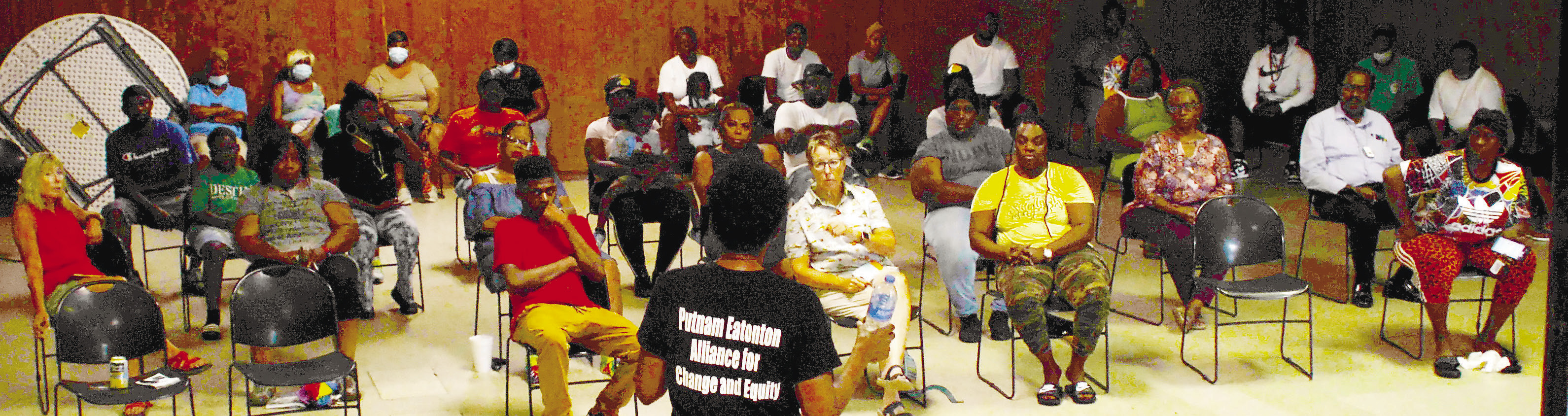
Last Thursday, sheets of monsoon-like rain drove local residents attending a rally at Jimmy Davis Park (JDP) indoors to the American Legion Hall next door—where a storm over the park’s fate resumed unabated.
“We are being discriminated against over here at Jimmy Davis Park,” retired electrician and nearby resident Lavoniah Sanders claimed in front of more than 60 concerned citizens, several seated beside young children.
“I know we pay taxes, but no taxes go in here for us to have recreation. We need recreation,” he continued. “These kids need to be out there playing basketball, playing all kinds of games, soccer, whatever. It’s not right and I’m tired of it.”
At issue was not only the current state of the facility but whether it’s the city or Putnam County that bears ultimate responsibility for the park’s condition and the future upkeep.
Several people stood up and directed passionate, concerned, sometimes angry comments toward those in local politics.
“The only football being played around here is of the political kind,” said one attendee who asked to remain anonymous.
“The city and the county both won’t take any responsibility.”
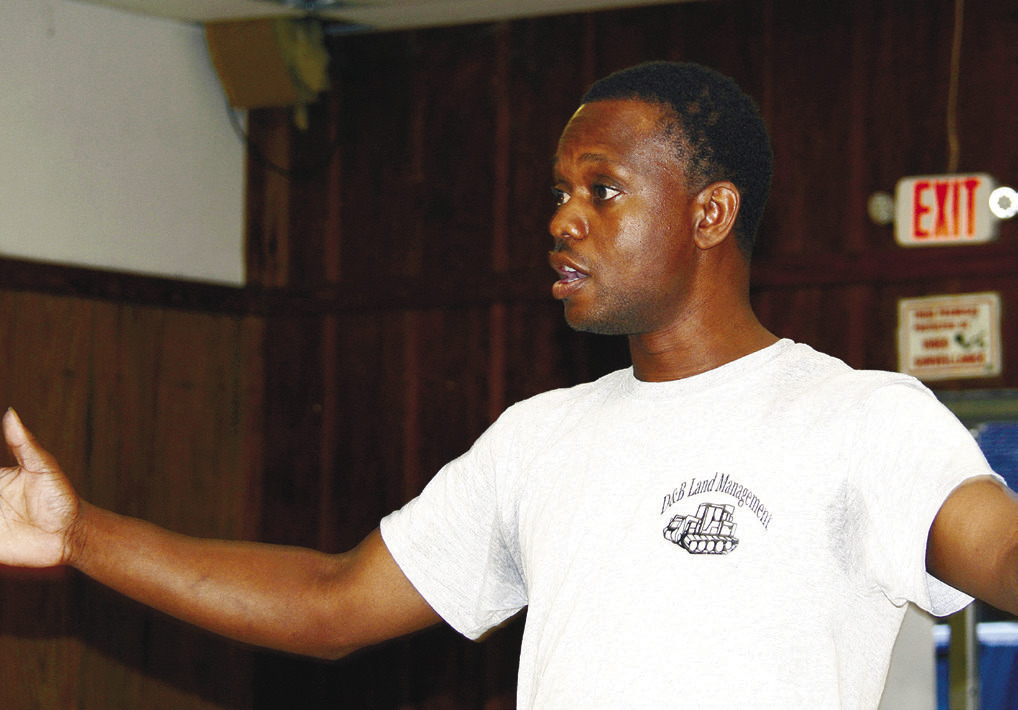
Local community organizer J.D. Jones told the crowd he is dismayed by the current state of the park, but praised a group of local men—John Ellison Jr., Vonte Brown, Eric Butts, James Waller and William Waller—for taking it upon themselves to cut the grass and clean up litter at JDP just days earlier.
“But this shouldn’t have to happen,” Jones added.
He insisted the park should be taken care of by the city since it originally received the deed from the state’s Department of Natural Resources (DNR) to more than 17 acres of land, six-and-a-half of which ended up as JDP, with a cemetery across the road accounting for most of the rest.
Situated just a mile southeast of Eatonton’s downtown, Jimmy Davis Park officially opened in 1969 and was named after the county’s first Black commissioner.
It originally featured outdoor basketball courts, a baseball diamond and a swimming pool (that eventually was filled in).
As the primary recreation and congregational center for surrounding neighborhoods, JDP eventually added walking paths, a soccer field and a community center for select indoor sports, after-school programs and special event rentals.
However, the City of Eatonton passed control of the park over to Putnam County in 2007, citing the county’s mandate to maintain and promote all recreational facilities within its borders. In recent years, though, JDP has been deteriorating with damaged sports equipment left unrepaired, grass and weeds allowed to grow wild, and the community center shut down and locked up.
County officials blamed vandalism and security concerns for the lack of maintenance and last year began suggesting the city resume responsibility for JDP’s future care. Things came to a head on June 21 this year, as Putnam’s current board of commissioners passed a resolution to return the park’s deed to the city. Within a month, though, Eatonton City Council issued its own intention to “… disclaim any title (to JDP) as a result of the actions unilaterally taken by the Putnam County Board of Commissioners.”
Representing Eatonton’s Wards 2 and 3, in which JDP is located, city councilmember Alvin Butts also attended the JDP rally, the lone sitting official from either city or county councils to do so. Butts said he also remains alone amid his city council colleagues in his support of keeping the park. But, he insisted, “the city never owned this park here, never did; it’s always been with the county.” He said Eatonton originally managed JDP only because it fell within city limits.
Butts then encouraged residents to attend upcoming county council meetings and to sign up as speakers and address the council with their concerns. He cautioned, however, that a one-and-done approach will not affect change.
“Don’t go as one or two, go in numbers,” he suggested. “And once you go the first time, don’t stop going, go back again and again. I’m telling you, that’s how it works.”
The councilman went on to explain that everyone who signs up to speak will be heard, but until an issue makes it to the county’s official agenda, speakers can’t expect a response from council to their concerns.
He also said citizens will eventually need to agree on one person to represent their cause.
“They (county council) are not going to address all seven or 15 or 20 people that speak; they’re going to speak or ask questions to just one representative; that’s just how they work.”
Regardless, the mood of residents surrounding Jimmy Davis Park suggests that the council, whether city or county, can’t work soon enough.
“Change is gonna’ come for Jimmy Davis Park,” Jones declared. “It’s just not gonna happen tomorrow. So we can’t give up two weeks down the road. We can’t give up at all. We all have to stay on top and make that change happen.”