
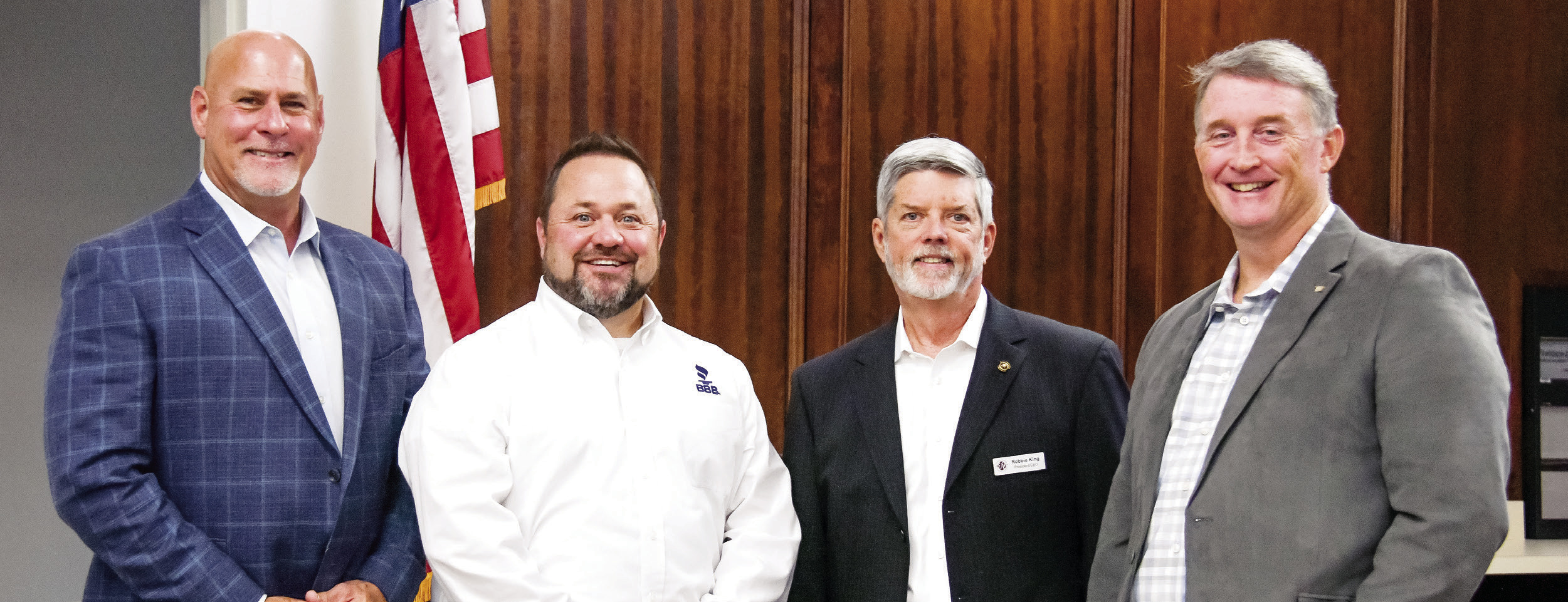
As part of its Business Breakfast Series, the Eatonton-Putnam Chamber of Commerce (E-PCOC) presented a community safety forum Oct. 28 at the county commission building, featuring a fraud prevention expert, a former state trooper, and a local trauma counselor.
Each delivered a unique yet ultimately unified message suggesting that living in a world of digital deception, physical danger, and emotional overload requires awareness, preparation, and healthy self-care instincts as defenses.
Introduced by E-PCOC President Robbie King, Better Business Bureau Vice President Jason Blankenship opened the session with a blunt warning about a recent rise in widespread scams.
“Ever since COVID, scamming is a definite thing,” he declared. “It has increased by 400 percent.”
To help people identify fraud, Blankenship outlined an acronym — BINGO — that stands for Beware, Identification, No, Gifts, and Others.
“Beware of any big checks that come to you unexpectedly, any big winnings,” he said. “Can you win the lottery without playing? No.”
He cautioned against high-pressure tactics that make people feel they must act immediately or somehow lose out. He stressed that good, legitimate deals or offers may have limitations, but not within a single phone call or sales pitch. In those cases, “No” should be the strongest word in your vocabulary, Blankenship suggested.
He also noted that oversharing online feeds another common form of fraud. “Those Facebook quizzes asking about your mother’s maiden name or your first pet’s name? They’re not for fun; they’re after your Information.”
He also warned against so-called free “Gifts” that lure people into scams. “What in this world is free?” he asked. “Nothing.”
When asked how to identify fake websites, Blankenship suggested looking for grammatical errors, missing contact information, and stock photos. There are also reverse-lookup tools for phone numbers and email addresses, reverse-image search for profile photos, and searches for usernames across platforms.
Following Blankenship was former Georgia State Patrol officer and member of the Governor’s Security Detail, Alan Hardwick, with a sobering talk on physical security and personal vigilance.
“We live in a very dangerous world,” Hardwick declared. “People are coming unhinged. It’s happening everywhere, suburban, rural, and urban.”
Hardwick shared his own acronym, “the Four Ps:”: Proper Preparation Prevents Poor Security.
“If you prepare properly, you can prevent poor outcomes,” he said, urging everyone to cultivate situational awareness.
“How many of you came in today and sat down without thinking about where the exits are?” he asked before describing three types of people in a crisis. “Heroes run to the violence, survivors have a plan, and victims panic,” Hardwick said. “Which are you going to be?”
He advised being mindful in everyday life, whether in restaurants, stores, parking lots, or behind the wheel, claiming distraction is one of the biggest dangers everyone faces daily.
“You have to have your head on a swivel,” Hardwick said. “Always know who’s behind you, who’s beside you. It drives my wife crazy, but I tell her, ‘Sweetheart, I’m just trying to take care of us.’
“We’re so distracted,” he continued. “You sit in a restaurant and everyone’s on their phone, and that’s exactly what predators look for, that moment when you’re not paying attention.”
The final speaker, Dr. John Wheeler, a former Navy SEAL and founder of Pathfinders Counseling Service in Eatonton, shifted the focus inward — to the mind.
“We talk about external threats all the time, but one of the greatest threats we face is how we think about control,” Wheeler said.
He introduced the psychological concept of locus of control, related to the belief about where control over one’s life resides.
“If it’s external, you’re letting the world — politics, your boss, even your spouse — dictate how you feel. But that’s irrational, you can’t control them,” Wheeler said.
Cultivating an internal locus of control would be better and healthier, he suggested.
“When I have a strong internal locus of control, I see external problems as things I can manage, not control. I can pivot, I can adapt, and I can move forward,” Wheeler said.
Drawing from his counseling work with veterans and first responders, Wheeler discussed trauma, PTSD, and what he called “moral injury,” typically involving guilt from witnessing or causing harm.
“Moral injury is guilt and shame-based,” Wheeler stated. “It’s different from PTSD, which is fear-based. But both can destroy you if you don’t address them.”
Addressing the lingering stigma around mental health in the military, Wheeler said the warrior ethos tells soldiers to be strong, not to show weakness. However, Wheeler added, when people follow that path and ignore their feelings, it often becomes self-destructive.
“The best way to heal is to externalize things, to talk,” he said.
Each speaker—from scam prevention to street safety to psychological resilience —essentially echoed the same theme: awareness. Whether online, in public, or in the mind, the greatest defense is attentiveness.
King summed things up for the assembled business owners and leaders by reminding them, “The next time something sounds too good to be true, or when the world feels overwhelming, remember BINGO, remember the Four Ps, and remember that self-control begins with you.”