
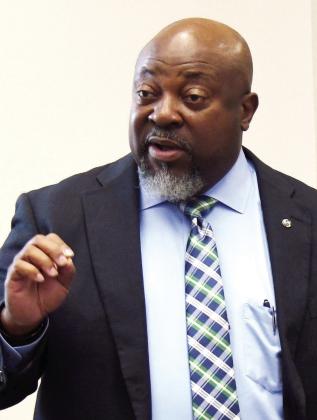
The Putnam County Charter School System (PCCSS) Board of Education held a pair of public education meetings on Monday about its Fiscal Year 2026 budget, with about a dozen citizens attending each time.
PCCSS Superintendent Derick Austin led each meeting at the PCCSS building on Old Glenwood Springs Road in Eatonton, with support from Finance Director Coretta Harris, and all board members in attendance. He initially established that PCCSS is not a charter system in the sense of being separate from the traditional public-school model.
“We’re a public school system that went charter [in 2010] for flexibility with some of the state laws so that we’re able to guarantee higher student achievement based on being able to waive some of the state laws that were in place to give you more flexibility, more local autonomy to make decisions,” Austin said. “That’s the rationale behind that.”
He began by explaining that 90 percent of the Putnam school system’s approximate $54.65 million FY26 budget is dedicated to meeting staff costs.
Among those costs is paying $22,260 for each and every certified (primarily teachers) and classified (all support staff) employee, “and that is not for health insurance, that is just so they can buy health insurance,” Austin stressed. “That is a state mandate that we have to meet.”
Health care costs to the PCCSS for all employees, both certified and classified, increased from less than $3 million in 2011 to about $5 million in 2023, but shot up to an expected $8.75 million this year and will approach $10 million in 2026, he added.
Austin further explained that Teacher Retirement System (TRS) costs have risen from less than $2.5 million in 2011 to more than $6 million this year, with similar increases expected to follow.
Meanwhile, annual state and federal funding has remained relatively static over the past few years, in the $6-$9 million range from the feds (other than a $19 million infusion in 2022 due to COVID funding), and from about $13 million to now $15 million from the state each year from 2019 to 2025.
The county’s tax contribution to the school system had remained stable at about $5-$6 million from 2019-23 but has since shot up to $24 million last year and is expected to reach $27 million this year.
Still, to the surprise of many in attendance, Austin explained the Putnam County school district is considered “wealthy” by the state.
As a result, it withholds $10 million in annual funding that the district has “earned” based on student population. This is a significant loss of revenue for the district, the superintendent stressed. Ironically, he added, based on the state’s criteria and calculations, Gwinnett County is deemed “not wealthy” and receives more state funding proportionally than Putnam County.
The Putnam school board is also facing several unfunded mandates and increasing costs, including the 22% increase in TRS contributions, a $10.2 million increase in healthcare costs, and the loss of $11 million in federal COVID-19 relief funds.
To make up for these losses and increased costs, the PCCSS is proposing to increase its millage rate from 10.724 to 11.983, which represents an 11.7% increase that’s expected to generate an additional $4 million in revenue. This represents a significant moment for the school board after a history of decreasing the millage rate over the last five years.
“Now, what the state makes us do, they make us advertise from the rollback rate, and the rollback rate would’ve cost us another $650,000,” Austin explained in response to an audience question about seeing a 20% millage increase mentioned. “They make us advertise off the rollback rate to go to the new rate that we’ve requested. So, when you saw the 20.03%, that’s where that came from. But it’s not a 20% increase; it’s 11.7%, which is a big difference.”
He added that the PCCSS millage rate remains lower than 90% of Georgia counties, in terms of education taxes.
Another audience question during the evening information session prompted Austin to confirm that a seniors’ tax exemption could exempt homeowners over 70 years old with homes valued under $500,000 from paying any school taxes.
There was also some debate and disagreement about the school board’s recent sale of the Putnam County Elementary School it replaced on South Washington Avenue in Eatonton. The school building and its 18-acre plot sold for $150,000 to the City of Eatonton, prompting concerns among some attendees about the transparency and fairness of the sale process.
Austin was adamant in shutting down any suggestion of a lack of due diligence, however. He said the school and its grounds had been offered for sale with a starting price of $6.5 million through Fickling & Co. It had attracted no competitive bids after several months on the market, which began even before school let out in May, so the decision was reached to make a deal with the city as its best opportunity to continue as a viable building.
He also said demolition of the building had been considered to turn the land it sits upon into a park-like green space, but that involved an approximate $1 million price tag. The city had expressed interest in the property to create an all-in-one complex for city services to operate from, and that seemed to make the most sense for all involved, Austin said.
“This school sits in the center of our town, and this board made a pledge that we were not going to leave a blighted property in the center of Eatonton,” he stated. “So, we accepted the offer that was best for the board and best for the community.
“It just didn’t make sense if somebody wanted to pay us $500,000, but they couldn’t pay the water bill, or they couldn’t pay the light bill, or they just didn’t care about the building and only wanted the land. How are we helping the community by allowing somebody to buy it if they don’t have the means or the interest to keep that building up and functional?”
Austin also said the board had estimates suggesting the cost of renovating the previous elementary school would rival that of its new, state-of-the-art elementary school on the east side of Eatonton near the current middle school. Even selling it significantly below any perceived market value seemed preferable to the board over carrying the expense of continuous upkeep at an empty property, he suggested.
“We don’t want to hold onto the building. We don’t want to build a new building and still keep an old building up that’s affecting our bottom line,” Austin told Monday night’s meeting attendees. “We wanted to get this building off our hands as quickly as possible.”
Following the afternoon meeting, Austin said he wanted to hold it in the interest of providing “total transparency” through answering any and all questions.
“We make it very informal, engaging, and we want people to know that we’re not trying to hide anything. We just want to be as transparent as possible,” he said. “We know that we’re representing the entire county, and we want to make the best decision for the county and not just a certain area of the county. So, some things are good for some folks, some things are bad, but hopefully, nothing is bad for everyone.
“I really think we’re on the right track, but are we perfect? No, we’re not perfect. But I would take this district and put it up against any school district in the state with the resources that we’re able to have in the county and the community and the kids that we have here,” Austin said. “So, I feel very good about where we are and look forward to what’s to come.”