
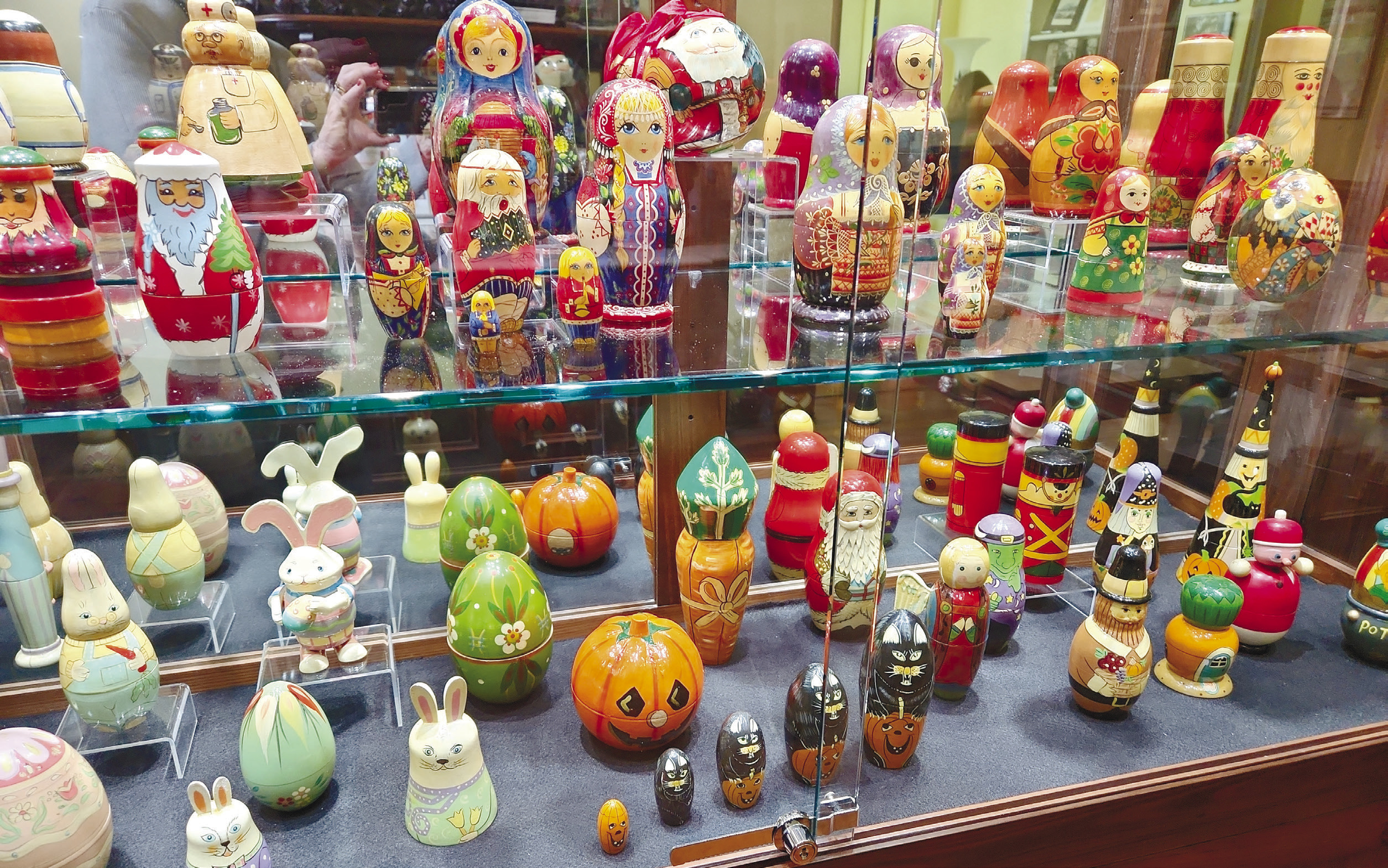
One of the joys of finding collections each quarter for the display cabinet in the front hall of the Madison-Morgan Cultural Center (mmcc-arts.org) is simply learning new things with every exhibit. Starting in April and running through June, Chandler Pike is sharing a lifetime collection of matryoshka dolls.
As a child, Chandler was given a matryoshka doll set, as well as a large, green-painted egg with the same ability to open, and inside you would find other eggs. Today, she literally owns hundreds of these artistic toys.
The first Russian matryoshka, which literally means “Little Matron” in Russian, doll set was carved in 1890 by Vasily Zvyozdochkin and hand painted by Sergey Malutin in a workshop called “Children’s Education” at the Abramtsevo estate, outside Moscow. The owner of Abramtsevo was Savva Mamontov, an industrialist and notable arts patron.
During the latter-19th century, Russia experienced a zenith in the arts backed by the nobility and rich businessmen, and landowners. Mamontov was no exception, with his wife presenting the dolls at the 1900 Exposition Universelle in France, where the nesting doll earned the bronze medal.
This promptly made the world fall in love with these cute, rotund doll stacks. It is important also to note these dolls were created during the Arts and Crafts movement, a popular global phenomenon of the time.
The first matryoshka set exhibited in France involved eight individual dolls, the largest being a woman holding a black rooster, making her better known as the “Rooster Girl.”
Inside her were seven dolls nested within each other and representing various aspects of Russian life in their hands: the rooster, a scythe, a bowl believed to contain porridge, and a broom. All eight dolls were clothed in traditional Russian peasant attire.
The biggest doll of the matryoshka set symbolizes the mother of a Russian family. The shape was inspired by a mother’s portly figure, depicting her fertility and significance as the center of the traditional Russian family. The act of nesting the dolls inside the biggest doll represents the mother and her ability to carry and conceive her sons and daughters. This justifies the basis of females always being the biggest dolls in the set.
Chandler has collected nesting dolls and boxes from Russia, China, Japan, Poland and India. Russia did not conceive the idea of stacking things inside the other, early examples of stacking boxes from long centuries before 1890 have been found in China and Japan.
However, Russia matryoshka dolls did begin the craze of stacking figures and later all sorts of wonderful colorful display items. These dolls are typically made of linden wood and are turned, not carved.
The value of matryoshka dolls largely depends upon their size – the largest known size is 51 dolls nested within the other, while the smallest set to be considered a matryoshka doll is three. The most common size includes seven dolls and value increases with the number of pieces and the intricacies of painted decorations.
In the MMCC Collector’s Corner Display cabinet, Chandler’s collection is divided among three shelves, with the lowest being an amazing collection of holiday matryoshkas, recognizing Christmas, Easter, St. Patrick’s Day, Valentine’s Day, Halloween, and so on.
The center shelf holds authentic Russian matryoshkas of every size, right down to amazingly small, while the top shelf presents matryoshkas from all over the world, some of them figural, while others are not. These include animal collections, portraits, and caricatures of famous politicians, musicians, athletes, and even astronauts.
In modern times, nesting dolls became canvases for political ideas, too, such as in the 1980s and ‘90s during the latter stages of the Soviet Union. Perestroika led to a liberalizing trend in the subjects painted on the wooden nesting dolls and it became common to see Soviet political leaders rendered on matryoshka, from Lenin to Stalin and all the way up to more modern leaders like Mikhail Gorbachev, Boris Yeltsin and even Vladimir Putin. A sample of those is included in the Pike Collection.