
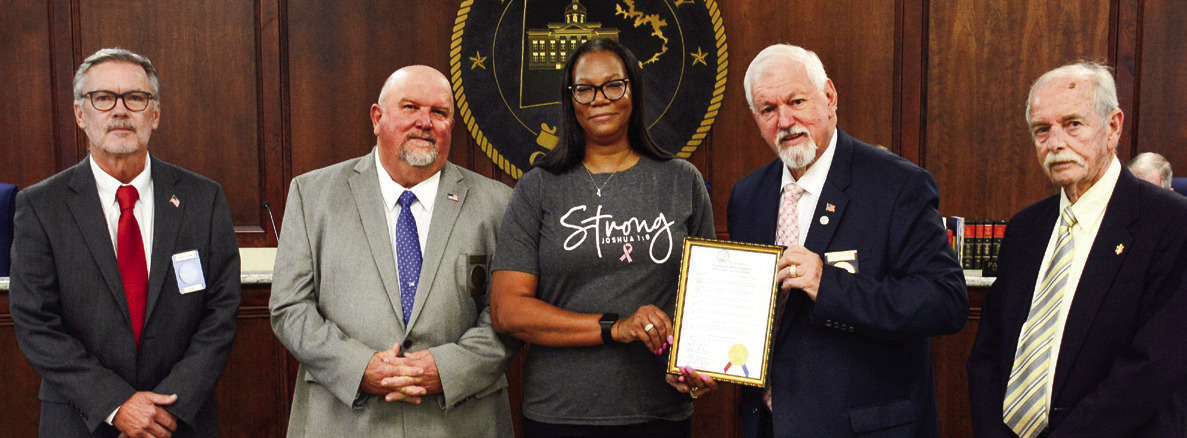
The Putnam County Commission held its first of two regularly scheduled monthly meetings on Oct. 4.
Public comments included giving thanks to county workers for cleaning up after Hurricane Helene, a citizen’s request for help with road repairs near their home, multiple SPLOST 10 oppositions, a request for more information from the commission about its position on SPLOST 10 issues, and a suggestion to improve access to Jimmy Davis Park.
Additionally, Josh Sprayberry, developer of the $165 million Len Resort project off Collis Road on the east side of the county, requested commissioners to sign a preliminary plat for the property, which Sprayberry said is being held up because County Manager Paul Van Haute claims the project does not have a water and wastewater provider.
“This statement is simply false, and Putnam County’s continued refusal to approve the application is unconstitutional and discriminative and arbitrary,” Sprayberry stated.
He claimed the county’s refusal to provide the preliminary plat is illegal on several levels and concluded by requesting the plat be accepted and approved “as submitted.”
County resident Kathy Wardlaw soon followed Sprayberry to the podium and admitted she had planned to address a different issue but felt compelled to respond to some of his comments and actions.
“After listening to Mr. Sprayberry up here and talking about ordinances and plans and things that he has given and he’s not given reciprocal, what do you call it? Rights and privileges to continue his development? I actually think it’s quite funny and interesting that I have a list here of questions and concerns about ordinances that are not being followed or upheld by our own county according to the plans that he has submitted,” Wardlaw said.
She proceeded to describe the combining and severing of several land parcels that now make up the Len Resort land properties. She debated whether the project is residential or commercial in nature, which may affect its meeting construction height limitations, among other issues.
As is customary, no immediate action was taken on any measures, but the commission assured everyone that all comments would be considered.
The commission also held a non-vote discussion of the upcoming renewal of its contract with the Eatonton-Putnam Chamber of Commerce. It was suggested that the county retain a larger percentage of tourism-related monies collected.
“The amount of the hotel-motel tax awarded to the Chamber of Commerce is excessive and not required by the Georgia Codes. That excess would be better utilized by the management of the county,” public speaker Tommy Jefferson suggested. “As an example, managing the growth of STRs (short-term rental properties) has created an expense and burden on the county, and the hotel-motel tax revenue should pay for that and all the permitting items that the county might need.”
District 3 Commissioner Stephen Hersey agreed with Jefferson, explaining that when the local hotel motel tax was initiated about 10 years ago, it took in approximately $100,000 annually. He claimed that tax income has since increased to more than $700,000.
“It’s just my opinion that a new resolution needs to be crafted such that the county receives more support for what we would refer to as tourism product development, which I think is what the code calls for,” Hersey said.
“Two questions come up for me,” he added. “The first is, is the county receiving an adequate share of the hotel-motel tax in comparison to what we are spending for tourism-related entities? The second question is, what is a tourism product, and how do we develop it?”
He then listed existing Putnam County features such as the county-owned-and-operated Uncle Remus Golf Course, the aforementioned Len Resort project, and potential county pickleball court construction, as each would presumably draw tourism dollars.
“When I look at OCGA 1351, which is the basic hotel-motel tax legislation, I believe our discussion of last time stipulated that we were probably working under Section B, Subsection 3, which allows for an 8% hotel-motel tax. And that has a specific in it that says that 50% of the collections in excess of 5% were to go to the designated tourism agency and 50% were to go to tourism product development,” Hersey explained. “Well, I don’t think the county is getting its fair share when we look at that specific law … which is arguably the most complicated law in the entire code of Georgia.”