
Victims pour into area for necessities
While Lake Country was spared the most intense winds and rain brought by Hurricane Helene, the storm has killed more than 110 people across the southeast, a number expected to rise in the coming days.
Thirty-five were killed in Buncombe County, North Carolina, alone. Georgia governor Brian Kemp said 25 fatalities had been reported in Georgia.
Among those fatalities were Assistant Fire Chief Bucky Goble of the Blackshear Fire Department, who was killed in the line of duty when a tree fell onto the cab of his city truck; Blackshear firefighter Leon Davis; Cherokee County firefighter Nevin O’Hearn; and Cobb County firefighter Elisabeth (Lisa) Barringer- Cook.
Following his aerial survey of the damage on the morning of Sept. 29, Kemp held a press conference. He said it looked as if the state had been hit by a “250-milewide tornado.”
According to Reuters, the storm also left more than 2 million homes and businesses across the Southeast without power. Internet and cell phone service has also been lost in some areas.
Chris Collins, the Georgia Director of Emergency Management and Homeland Security, said that Verizon had 328 sites out of service and AT&T had 255 offline.
Georgia Power is calling the storm the most destructive hurricane in the company’s history, damaging infrastructure across the state.
“The entire state of Georgia has been affected by the storm, with the hardest hit areas including Savannah, Augusta and Valdosta,” Georgia Power said in a press release issued Sept. 27.
Initial damage repair estimates reported reported by Georgia Power Monday include:
• more than 7,000 power poles that must be repaired or replaced;
• more than 700 miles of wire;
• more than 1,200 transformers;
• more than 3,000 trees on power lines must be removed or addressed to restore power
According to Greene County’s Emergency Management Agency Director Joe Bashore, local officials monitored the storm moving into the area from Thursday night into Friday morning. At night, they activated the county’s Emergency Operations Center (EOC).
“We were fortunate,” Bashore said. “It appears the eye of the storm moved over our area as the high winds hit the area to the east.”
Bashore said approximately 10 homes in Greene County were damaged by trees, and the Greensboro Police Department reported two homes damaged in the city limits. More than 130 trees had to be removed from roadways and cleared from power lines when it became safe enough to do so.
Greene County dispatched ambulances to Augusta to help evacuate patients from hospitals in the area unable to provide the necessary level of care. Local residents who made the trip said there was so much debris on I-20 that the one-hour trip took more than three hours.
Bashore said no serious injuries from the storm were reported.
Morgan County manager Adam Mestres echoed some of Bashore’s comments during remarks he made during the Morgan County Board of Commissioners’ meeting held Oct. 1.
“We were very fortunate in our community that the storm shifted the way it did, shifting east,” Mestres said. “It’s unfortunate for our friends and neighbors to the east of us, who got devastated by [the hurricane]."
Mestres said he has family in the North Augusta area who have been told not to expect power before Oct. 12.
Morgan County activated its EOC on Friday at noon with support from the City of Madison and representation from Morgan Medical Center and the school system.
“We took maybe a dozen or so tree-down calls throughout the night,” Mestres said. “[When] the end of the eye of the storm passed through, is when it really got us,” Mestres said. “In a 30-minute window, we went from about 1,500 power outages to somewhere around 4,300 countywide. As of [Sept. 30], everyone’s power in Morgan County has been restored, so that is really good. All the roads are passable.”
As of Sept. 29, Georgia Power was reporting that electrical service to customers in Greene County had been completely restored. Rayle EMC, which provides electricity in some parts of Greene County and nearby counties, had only a few customers without power in Lake Country.
On Friday morning, Sept. 27, Georgia EMC said 106,947 customers were without power in southeastern Georgia, and another 120,737 in southern Georgia were without service; 65,994 customers were down in eastern Georgia.
By Monday, Sept. 30, two-thirds of EMC customers in southeastern Georgia had their power restored, and approximately one-third had their lights on in southern Georgia. About half of customers in eastern Georgia had power restored.
Georgia Power said that as of Sunday evening, it had restored power to 740,000-plus customers statewide.
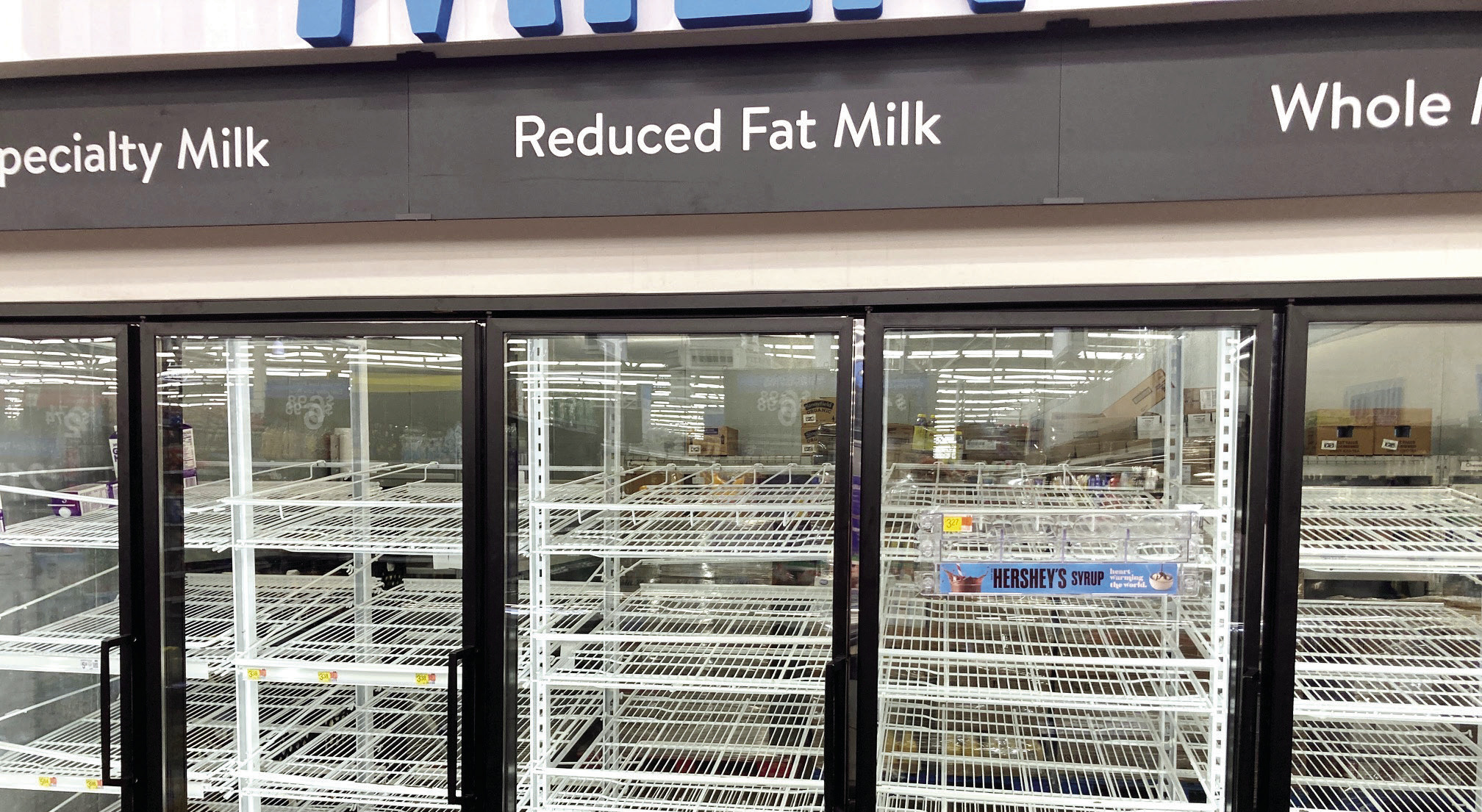
With power outages and flooding closing businesses all over eastern Georgia and the Southeastern United States, victims poured into Lake Country to purchase necessities. This led to traffic tie-ups in the interstate area, empty grocery store shelves, and long lines at local gas stations.
The Publix parking lot on Hwy. 44 was filled to capacity on Monday morning as storm victims continued to pour into Lake Country for food, bottles of water, and other items unavailable in some areas east of Greene County.
Mestres said that many of the people coming had nothing left in the aftermath of the storm.
“They’ve thrown their food out of their refrigerators, so they’re coming to get non-perishables from our grocery stores because we’re the first stop [after Greene County],” Mestres said. “I just ask that we be considerate as a community and welcome these folks. It is a little taxing on us; fuel lines are longer, and grocery store shelves are empty. But they’re taking their groceries and going back home, and they’ll probably have to come back up here again because they’re looking at two weeks before they get power.”