
Tragically, at least 25 people in Georgia lost their lives to Hurricane Helene. At the same time, the far south and eastern side of the state suffered billions of dollars in total damage. As of Tuesday morning, approximately 350,000 people remained without electric power statewide.
Fortunately, Putnam County was spared mainly Helene’s wrath, with relatively minor damage and no serious injuries reported that were directly attributable to the storm.
“Yes, we got prepared, and we were ready, but I think Putnam County got very lucky as most of the storm damage went around us,” Putnam County Fire Chief Thomas McClain said. “We did have some minor damage with power lines and trees, but to the best of my knowledge, we didn’t have any injuries or any homes with significant damage from the storm."
McClain added that the county fire department responded to “a little over 30 calls" for assistance during the storm, most of which involved downed trees, power lines, and minor damage.
“But luckily, nothing major, and all the firefighters and public works employees were safe,” he said
Putnam County Sheriff and EMA Director Howard Sills said he was aware of approximately 20 to 25 trees knocked down across the county but praised Eatonton and Putnam County road crews, as well as all city/county fire department and police officials, for responding quickly and taking care of any problems the storm caused.
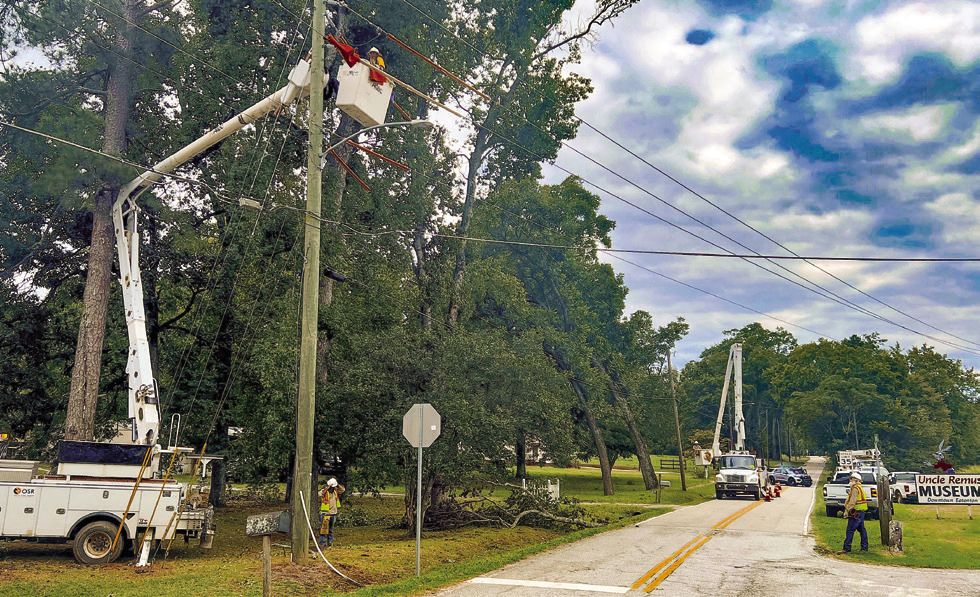
Anna Smith, a communication specialist with Tri-County EMC, said local power outages peaked at approximately 8 a.m. on Friday. Approximately 5,200 meters of power were lost, affecting members in Putnam, Jones, Baldwin, Twiggs, and Wilkinson counties.
“There are a little over 11,000 Tri-County EMC meters in Putnam County alone,” she said. “By 11:30 p.m., most outages on our system had been restored, and crews continued to work through the weekend to finish the rest.”
Still, local crews could not just go home and rest. Smith explained Tri-County’s linemen then moved on to assist in power restoration efforts elsewhere in the state.
“The cooperative model promotes ‘Cooperation Among Cooperatives,’ meaning that we work together when local, statewide, and national disasters strike,” Smith explained. “On Saturday, Tri-County sent a South District line crew to Little Ocmulgee EMC in Dublin and a North District line crew to Altamaha EMC in Lyons, where they can further assist with storm restoration efforts. South District is our Gray office, and North District is Eatonton.”
Similarly, Georgia Power said it deployed more than 15,000 personnel statewide in response to Hurricane Helene and declared it the most destructive hurricane in its history on Monday.
By Tuesday morning, Georgia Power crews had completed most repairs near their initial staging areas. They then began converging on the hardest-hit coastal, eastern, and southern Georgia areas, including Valdosta, Augusta, and Savannah, and their surrounding communities.
However, in many cases, the infrastructure damage is so severe that the repair teams cannot just repair specific elements; instead, they are forced to rebuild parts of the power grid.
By Tuesday afternoon, Georgia Power estimated that statewide, at least 7,000 power poles would need to be repaired or replaced, at least 3,000 trees or limbs would have to be removed to address restoring power, and more than 1,200 transformers needed replacement or significant repairs. The equivalent of more than 700 miles of wire had to be replaced.
Agriculture, too, is expected to suffer extensive financial losses in Hurricane Helene’s wake. Affected producers are already reporting yield losses ranging from 35% to a total loss, depending on location in the state. Producers also have reported significant losses in farm structures, equipment, and infrastructure.
In the coming weeks, official loss reports will undoubtedly mount as University of Georgia Cooperative Extension Service personnel collect data expected to reach hundreds of millions of dollars in Helene-related losses. These losses will extend well beyond the farm, as cotton gins, other agribusinesses, and rural communities will feel the ripple effect of Hurricane Helene’s aftermath for years.
Farmers are encouraged to document damage and losses before, during, and after cleanup and maintain accurate financial records of all cleanup and repair efforts. Assistance and crop insurance may take some time to arrive.
Additionally, the Federal Emergency Management Agency (FEMA) announced early Tuesday morning that President Joe Biden approved federal disaster assistance for Georgia to supplement its recovery efforts in the areas affected by Hurricane Helene since Sept. 24 and continuing.
Federal funding became available to affected individuals in Appling, Brooks, Coffee, Columbia, Jefferson, Liberty, Lowndes, Pierce, Richmond, Tattnall, and Toombs counties.
Assistance can include grants for temporary housing and home repairs, low-cost loans to cover uninsured property losses, and other programs to help individuals and business owners recover from the effects of the disaster. Federal funding also became available to state and eligible local governments and specific private nonprofit organizations on a cost-sharing basis for emergency work in each of the mentioned counties.
Federal funding is also available on a cost-sharing basis for statewide hazard mitigation measures.