

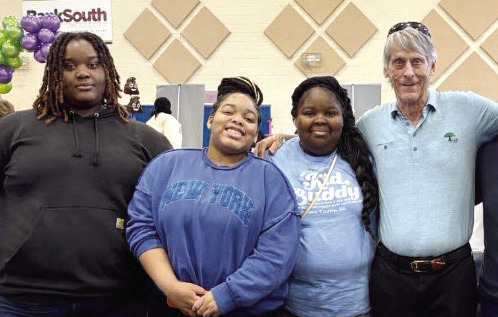
Dave Thillen, founder of the Thillen Education Foundation, was recently interviewed by Jim Masters, host of the “Close Up Radio” podcast, highlighting a program that is reshaping outcomes for high school students in Greene County.
Masters invited Thillen after learning about the foundation’s innovative approach to traditional high school education — one that has helped achieve a 100% on-time graduation rate among participating students, most of whom come from predominantly lower-income households. In addition to the broadcast, Close Up Radio distributed the podcast to more than 2,000 media outlets across the United States and Canada. The podcast is available on Spotify and Apple Podcasts by searching “Dave Thillen.”
Thillen never knew his father and was raised in inner city Chicago by his mother who had an eighth-grade education.
His mother had her first of five children at 15, and financial hardship defined much of his early life. Of the five children, Thillen was the only one to graduate from high school.
As a young boy growing up in Chicago, he was forced to be “cool” or go to school. After his family relocated to the north side of Chicago, Thillen enrolled in a grade school, where he observed a stark contrast in academic culture. His peers took school seriously and he quickly learned it was “cool” to go to school.
His grades went up and he was named president of his 8th grade graduating class. “That was the moment I realized education was my path out of poverty,” Thillen said.
He went on to earn both a bachelor’s and a master’s degree in mathematics and spent 30 years working for IBM. For his military service, he was an instructor and gymnastic coach at West Point.
After retiring, he and his wife, Elaine, moved to Greensboro.
Giving Back in Greensboro
In Greensboro, Thillen spent 15 years volunteering with Habitat for Humanity. Recognizing the role of technology in education, he ensured each newly built Habitat home included a working computer and internet access.
He soon began mentoring Habitat students, encouraging them to focus on academics and jointly develop individual career plans. Early encouragement efforts included a $1,000 scholarship and a laptop computer for each student going to college, technical college or joining the military.
The results were striking. After 15 years, 92% of all high school students in Habitat homes graduated and 81% went on to college, technical college or the military.
Thillen identified a clear pattern: students who received consistent guidance, support in developing a plan, and modest incentives achieved stronger academic outcomes.
Expanding the Model
Thillen’s success drew the attention of John Ellenberg, then CEO of Greene College & Career Academy. Ellenberg approached Thillen with a challenge: expand the mentoring model to serve all 450 students at Greene County High School. They formed a partnership with the goal to - End generational poverty in Greene County.
Thillen spent six months developing a scalable, structured program.
The initiative launched with the freshman class of 2018, supported by 26 local volunteers serving as career coaches. Each coach was assigned three to four students, committing to work with them throughout their high school years.
As the inaugural class advanced, additional coaches were recruited for incoming freshmen.
Within four years, the program expanded to reach the entire student body, ensuring every student had access to a dedicated career coach.
Since the beginning, the Thillen Education Foundation has recruited over 230 volunteer career coaches.
Keys to the Program’s Success
The Thillen Education Foundation’s model is built on four integrated components designed to keep students engaged and focused on post-graduation goals:
• Skills-Based Learning: Through Greene College & Career Academy, students can choose from 17 career pathways, including audiovideo technology, culinary arts, early childhood education, emergency medical services, welding and automotive technology. In the fall 2 new pathways will be offered - Heavy Equipment Operations and Computer Science/ AI. These pathways provide practical, job-ready skills aligned with high-demand industries.
• Dedicated Career Coaches: Each student is paired with a volunteer coach who provides mentorship, exposure to career opportunities and consistent support over all four years of high school. Coaches come from a wide range of professional backgrounds, including healthcare, law, education, sales, engineering, professional athletics, and the military.
• Individual Career Plans: Beginning in ninth grade, students work with their coaches to develop personalized career plans — an approach influenced by Thillen’s experience at IBM. These plans evolve over time and help students identify clear next steps after graduation, whether in college, the workforce, as an entrepreneur or the military.
• Financial Incentives: Students earn financial awards based on attendance, academic performance, behavior, community service and progress on their career plans. Funds accumulate throughout high school and are distributed upon graduation, reinforcing long-term commitment and achievement.
The program is supported by a customized Salesforce platform that allows coaches to track student progress, monitor grades and schedule meetings. The system also enables communication with parents and helps facilitate recognition events — an important factor in maintaining family engagement.
Community Support and Sustainability
Community involvement has been central to the program’s success. The foundation conducts a single annual fundraising campaign on Giving Tuesday, with all proceeds directed toward student support.
These efforts have helped establish a professionally managed $2.3 million portfolio. The return on investment covers all operating expenses, allowing 100% of donations to go directly to supporting the students. Every participating student in every graduating class receives financial assistance to continue their education, enter the workforce, become an entrepreneur or joining the military.
The amount of financial assistance continues to grow with the class of 2026 being awarded $1/3 million.
A Model for the Future
Now in itseighth year involving 5 graduated classes, the program has produced measurable results, including steady increases in graduation rateswith 100% of participating students graduating on time or early over the past twoyears.
“The program is working,” Thillen said. “It’s been incredibly rewarding to see teachers, administrators, students, coaches, the school board and parents come together around a shared commitment to student success.”
For the first five graduated classes, financial assistance totals over $1 million with annual distributions continuing to rise.
As educators nationwide search for ways to improve outcomes in underserved communities, the Thillen Education Foundation’s model offers a compelling example of what sustained mentorship, structured planning and community investment can achieve.
— Contributed