
PUTNAM COUNTY
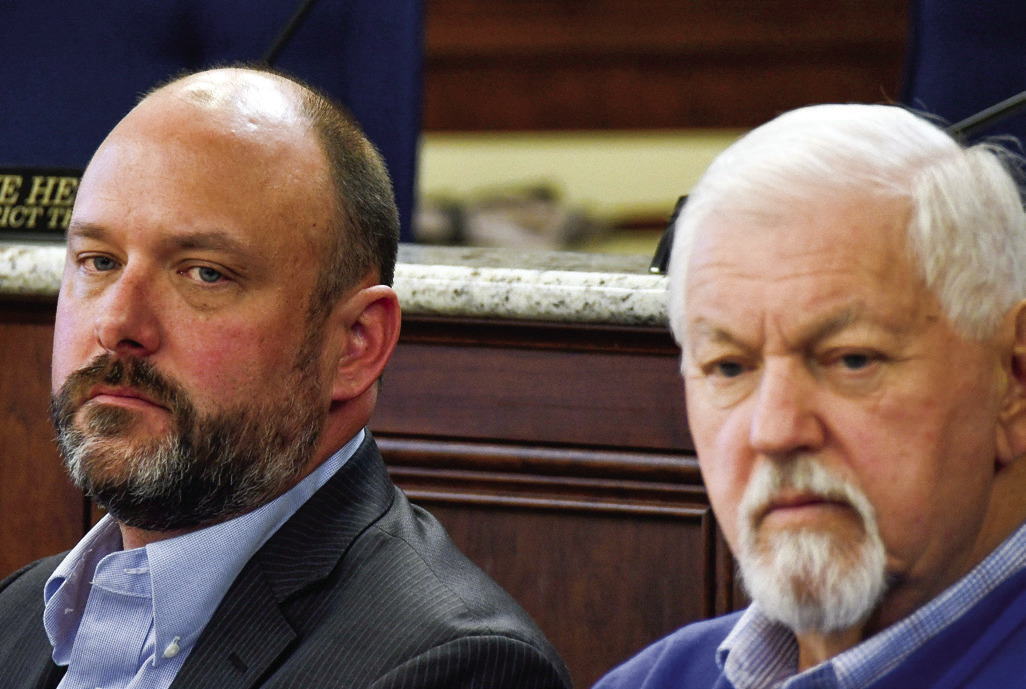
At a joint public meeting marked by candor, frustration, stern faces, and multiple calls for better communication, the Putnam County Board of Commissioners (BOC) and the Putnam Development Authority (PDA) spent about two hours Jan. 22 discussing their working relationship, public trust, and the controversy surrounding a proposed tax abatement tied to a large residential development.
Approximately 30 citizens, county employees, and other interested people also attended the meeting, though none were permitted to question or otherwise address the participants directly.
BOC Chairman Bill Sharp opened the meeting by stressing its purpose was dialogue, not confrontation, adding that PDA members deserved respect for their volunteer service.
Much of the discussion centered on a proposed development known as the Helms College project, off Harmony Road and adjacent to Lake Oconee on the eastern border of the county. Primarily at issue was the PDA’s plan to structure it through a bond-fortitle arrangement that would effectively exempt much of the property from taxes for several years, perhaps decades. While several commissioners said they supported the project itself, they objected to the tax implications and the process used to advance it.
District 3 Commissioner Steve Hersey was among the most critical, saying the board had twice rejected the idea of granting tax relief for the project.
“Most people are not opposed to the project,” Hersey said. “They’re simply opposed to the tax abatement … we don’t need to subsidize this project with taxpayer dollars.”
Hersey also questioned whether the PDA, created by a 1968 constitutional amendment, remains the right structure for Putnam County. He argued for establishing or reviving a statutory development authority to provide closer oversight by elected officials. Referring to recurring communication gaps between the BOC and PDA, Hersey suggested placing a county commissioner as a PDA member “would solve that issue to a large extent.”
However, county attorney Adam Nelson interjected to explain that the PDA’s constitutional status limits the commissioners’ authority over it.
“Most of their operations are intended to be done by an independent entity,” Nelson said, adding that commissioners generally can appoint members but lack direct control. He also said removal of PDA members likely rests with the General Assembly or the governor, not the county.
Several commissioners emphasized that the core issue for them was not legality, but transparency and coordination.
District 1 Commissioner Tom McElhenney said he respected the PDA but wanted clearer reporting and record-keeping.
“I’d love to see a little more meat in your report,” he told PDA Director Matt Poyner. “I think the public needs to know what you do.”
Commissioner Richard Garrett of District 2, which includes the City of Eatonton, framed the dispute as a lesson in how development politics have changed.
“The very novelty of that [Helms College] project … collectively underestimated the need to make the case to the public,” he said.
To address the issue, Garrett suggested appointing a formal commission liaison to attend PDA meetings, as commissioners do with the hospital authority.
PDA Chairman Walt Rocker responded by saying the authority deliberately sought commissioner input by presenting a memorandum of understanding on the project.
“The intent behind the MOU was to give y’all … another bite of the apple,” Rocker said.
He suggested that the developer, Southeastern Development Associates, based in Augusta, was unusually responsive to neighbors.
“This is an anomaly in the development world,” Rocker said. “They immediately said, ‘Okay, we want to be good neighbors.’”
PDA member John Wojtas said the PDA tries to balance growth with accountability.
“We’ve never been a rubber-stamp board,” he said. “We always looked at it and said, what can we do to hold the developer responsible for completing the project?”
He noted the plan did not involve a full tax exemption.
“This was never a 100% abatement,” Wojtas stated.
Several PDA members expressed concern that the public dispute could damage Putnam County’s reputation with the state and potential investors.
“If we don’t have support, the state will not look at us to help us bring in projects here,” said longtime board member Patty Burns, who also serves as the PDA treasurer. “They will not do it if we’re all squabbling about stuff.”
Mylle Mangum, another PDA board member and City of Eatonton council member, echoed that sentiment, saying communities are judged on how they treat business.
“We live in an enormously competitive environment,” she pointed out. “The tools that we have to attract business are important … and how we look as a county is extremely important.”
Poyner, who appeared visibly uncomfortable throughout the session, acknowledged communication shortcomings but emphasized legal constraints.
“There are times when I may have to sign an NDA (non-disclosure agreement) with a company,” he said. “I can’t even let these people know who I’m talking to. That’s just the nature of the beast.”
By the meeting’s end, no formal decisions were reached. Still, there was broad agreement on at least one next step: establishing a regular liaison role to improve communication between the commission and the PDA.
Garrett called it “an easy fix” that could “go a long way to just removing some of the noise and misunderstanding.”
Sharp closed by allowing final comments and signaling that the conversation would continue. While divisions remain — particularly over tax policy and authority structure — both sides repeatedly emphasized a shared goal.
“We’re here to move the community forward,” Wojtas said. “That’s all we’re trying to do.”