
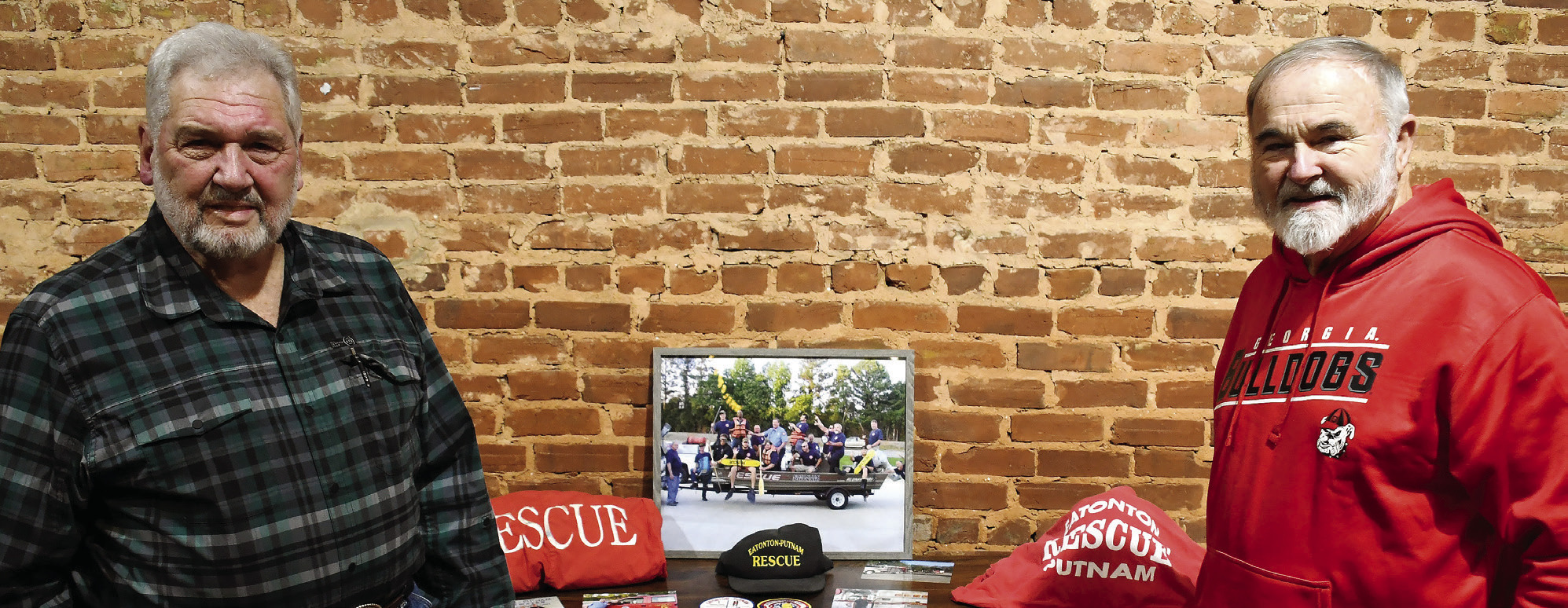
When Joe Thompson and James Gregory agreed to meet at Eatonton City Hall in June 1974, they had no idea of what they were getting into.
They also had no uniforms, no equipment, and no guarantee of income. What they did have, however, was a shared belief that Putnam County needed something it didn’t yet have: an organized rescue service to help out when lives were on the line.
Speaking last Friday evening at downtown’s Barrel 118, shortly before the annual dinner honoring the Eatonton Fire Department got underway, the two retired public servants discussed their early days on the job.
“At the time, there was a city fire department, and there were ambulances, but there was no county fire department and no emergency rescue service,” Thompson said. “So, Lynn Stanford, who was a deputy then, saw a need to have a group of people they could call when manpower was needed.”
Stanford gathered together a group of interested men, and the first question was blunt and mercenary.
“It was, ‘Are we going to get paid?’” Gregory recalled. “And we were told, ‘No, this is going to be volunteer.’”
Many didn’t return for the next meeting. But Thompson, Gregory, and about a dozen others did.
“You had to start somewhere,” Thompson reasoned.
What they started with was little more than ingenuity. The county gave them an old school bus, which the new rescue personnel quickly retrofitted by removing seats, installing a small stove, and outfitting it with largely homemade, handed-down, or borrowed equipment.
“It wasn’t meant to be an ambulance,” Gregory said. “It was more like a control center.”
“We made our own hand tools,” Thompson added. “Boat hooks, come-alongs, crowbars — anything we could get or build, that’s what we used.”
In those early years, rescue meant whatever the situation demanded.
More often than either Gregory or Thompson care to recall, tow trucks were used to pull cars apart or tear them open in order to extricate drivers or passengers. It was a crude, potentially dangerous practice — to victims and rescuers alike.
“Anytime somebody was lost or hurt, they’d call rescue,” Gregory said. “Car accidents or if they had a drowning in the lake, they’d call us. Our members brought their own boats. They built drag devices themselves. We just grew from there.”
The rescue group was informal at first, but by 1977, things began to change.
“That’s when it started becoming more professional,” Thompson said, especially when the county began asking the rescue group to assist with ambulance coverage.
“We only had two ambulances then and only one on weekends, so if one had to go out of the county, it meant the county was uncovered,” Gregory said. “They’d call us in, and we’d stay with the other ambulance until [the first one] got back.”
Training followed. Some members took advanced first aid, then EMT courses. Equipment slowly improved as well, but critical tools remained absent.
“We didn’t have the Jaws of Life in this county until 1981,” Gregory said. “If we needed them, we had to call Baldwin County to bring them up to us.”
That delay sometimes came at a terrible cost. A devastating wreck involving a local family and multiple fatalities finally brought action.
“That wreck is what got the Jaws of Life here. It happened on a Saturday night. On Tuesday, they delivered them,” Gregory said. “It took until someone that they really cared about didn’t make it. The county commissioner bought them. And now, there’s a set of Jaws of Life on every [rescue] vehicle we’ve got. “
Looking at today’s modern equipment and facilities, the contrast is striking.
“I walk in there now and just say, ‘Wow, look at what this all involves,” Gregory said.
Thompson remembers his first hard hat — one of 10 donated by a sympathetic Georgia Power supervisor he met on the road one day.
“I wrote ‘Rescue’ on it with a marker; that’s what we started with,” he said.
What never changed, though, was their motivation or dedication to the job.
“Somebody had to do it,” Thompson said. “And we were able to; and we wanted to.”
For decades, when pagers went off, they responded to car wrecks, fires, drownings, hunter accidents, and rescues of any and every kind.
Both men said they feel proud of what today’s Putnam County emergency services can provide and how they still stand on a foundation of service at all costs that they established. Gregory went on to take over the county ambulance service in 1980. He ended up serving more than 33 years in Putnam County. He left in 2013 to continue his career in Jasper County for another couple of years before retiring for good.
Thompson stayed with Putnam County Rescue even longer.
“I lasted 50 years,” he said, referring to his official retirement last June. “When I came in, Rescue wasn’t even in the state pension system; we never got in it. They are now, but we never did.”
Neither man considers or describes himself as anyone special, and certainly not as a hero.
“We’re just one small part of a big puzzle,” Thompson said.
Still, both acknowledge the weight of what they saw and did.
“There’s a lot of stories, a lot of weight we carry with us,” Gregory said, with Thompson immediately agreeing.
“There was a lot of crying sometimes,” he acknowledged.