
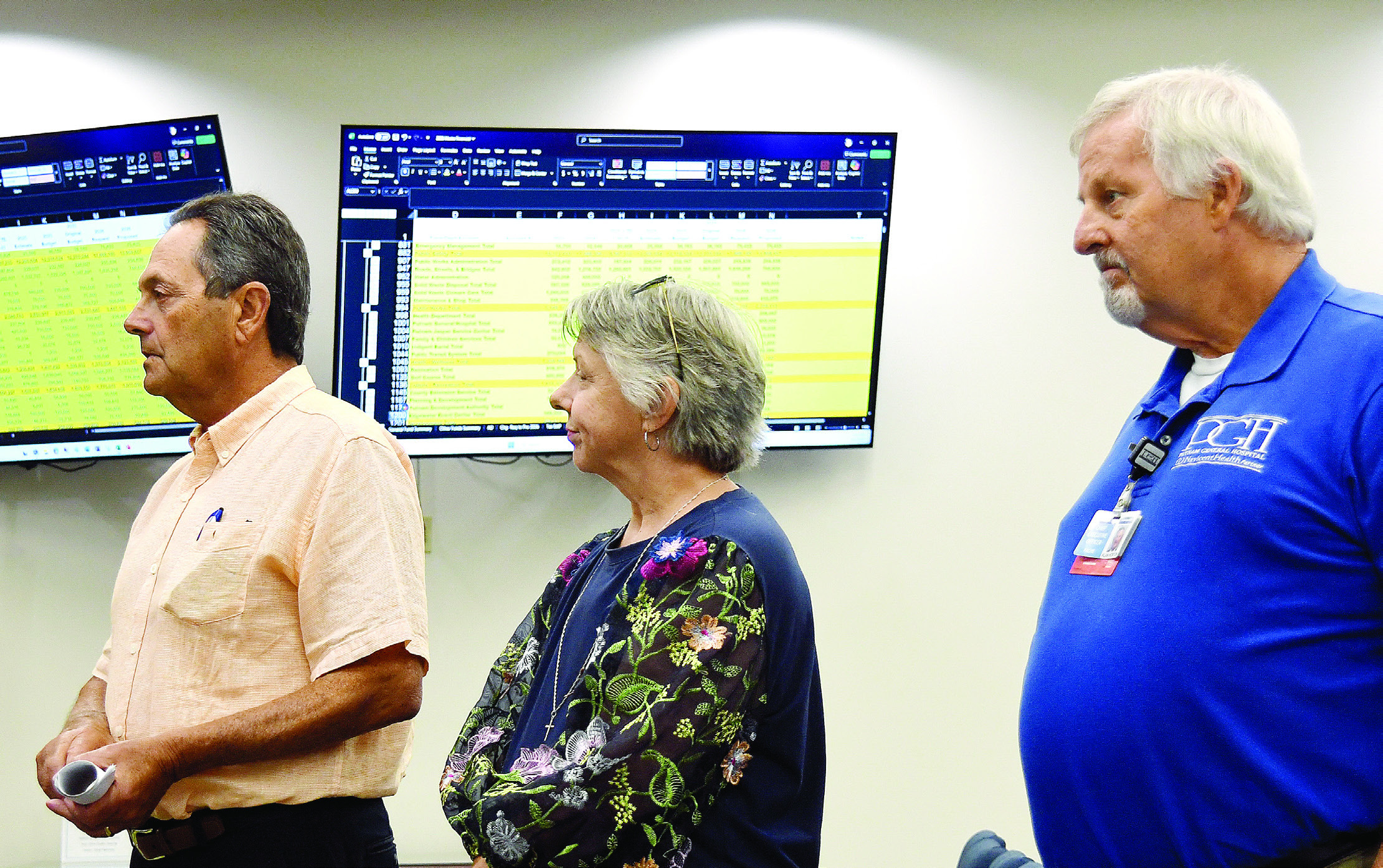
Putnam General Hospital (PGH) made an impassioned plea for financial help to increase staff pay last Friday afternoon during a work session for the Putnam County Commission.
Stepping to the microphone in front of County Chairman Bill Sharp and Commissioners Tom McElhenney (District 1), Richard Garrett (Dist. 2), Stephen Hersey (Dist. 3), and Jeff Wooten (Dist. 4), was Georgia Writers Museum President Lou Benjamin, also a member of the Putnam General Hospital (PGH) Authority Board.
“One of the first things I learned about economic development is that there are three things that any company coming into an area asks first. They ask about healthcare, they ask about education, and they ask about workforce availability,” Benjamin began.
“We can only talk about one of those things today, and that’s the healthcare situation. But I can tell you from an economic development standpoint, you don’t have any without healthcare. If you don’t have a hospital, it’s almost impossible to attract companies and industry to your area. And we on the hospital authority are aware that there’s probably some sentiment from people who think we give money to a losing deal every year.”
Benjamin went on to describe an unorthodox way of thinking that actually would help bolster the PGH's bottom line.
“The first thing I want to talk to you about is that by increasing payroll and increasing salaries, we will save money,” he stated. “I know, that sounds stupid, but right now, we are significantly underpaying the staff at our hospital relative to every standard you can imagine.”
Qualified RNs pass over PGH for pay reasons alone, Benjamin said, forcing it instead to retain at least eight nursing positions through an employment broker at approximately $95/ hour. That creates a related problem, too, he added. Hiring someone at a higher salary today also requires giving a raise to those in the same role who were hired previously.
“So, one of the significant cost increases to the hospital right now is we’ve got to bring our people up closer to market so that they will come on board [and then] we can save the inordinate amount of money that we’re paying for contract employees,” Benjamin explained.
PGH Human Resources Director Rhonda Largo also addressed the commission, confirming Benjamin’s statements. Largo used a registered nurse’s pay rate as an example, explaining PGH typically pays $32-$36/hour, compared to a competitive rate of approximately $45/hour statewide, including at hospitals in Milledgeville, Greensboro, Madison, and Athens, among others.
“I get applications all the time, and we go through the interview process, but we can’t match what other people are paying. We just can’t,” Largo told the commission.
She said she and her staff consistently attend job fairs seeking new nurses, but without competitive pay rates, it’s nearly impossible to attract employees to PGH.
“You’ll see the students; they walk right by Putnam because we’re not big and flashy. But what they don’t understand is that they’d get to do everything at our hospital,” she said. “We’re so small that our people wear so many hats … so it’s really a great place for people to start out. But we just can’t pay the market rate.”
Answering a question from McElhenney about PGH's finances, Largo explained that when she joined the hospital five years ago, PGH was heavily indebted to Navicent Health in Macon.
“They helped bail us out before with several million dollars, and we have worked so hard to pay that off so that we don’t have any debt now,” she said. “So, we’re pretty proud of that.”
Ironically, however, that debt-free status works against PGH when it comes to securing state-provided financial support. Hospital CEO Alan Horton explained to the commission that because PGH is presently debt-free, it is not considered as “needy” as hospitals that are underwater, financially speaking.
For example, he suggested St. Mary’s Hospital in Greensboro consistently carries debt, though many would consider it a more prosperous hospital than PGH.
“And there are other hospitals like them that are rated ahead of us in terms of need, but we take a lot of pride. I mean it took us a long time to get out of debt, and we don’t want to be there again,” Horton said. “We know it has more cost than just paying the principal back. You’ve got to pay interest on that as well, so we worked hard to get out of debt, but because of that, we are not ranked as most needy [under the Georgia HEART designated taxes program].”
No action was taken on the matter during the work session, though it could be revisited during a future council meeting.