
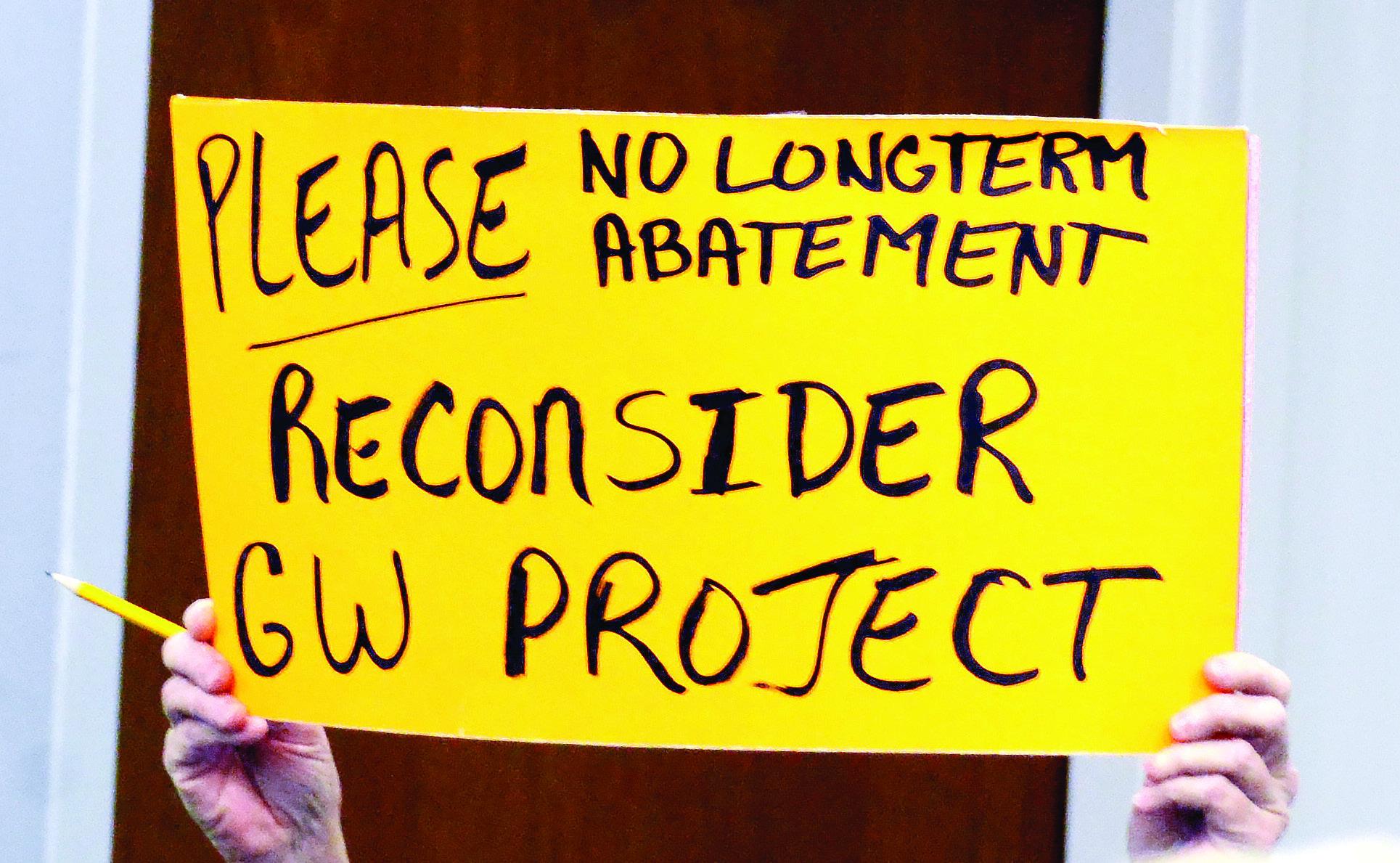
During the Feb. 7 Putnam County Commission meeting, a hearing was held to authorize Putnam County Commission Chairman Bill Sharp to sign an acknowledgment of a Memorandum of Understanding (MOU) between the Putnam Development Authority (PDA) and Harmony Road, Georgia, LLC regarding the construction of a residential development off Harmony Road on the eastern edge of the county.
The MOU includes a request for a 20-year tax abatement agreement for the developer, Southeastern Development Associates, based in Augusta.
The project would be built on approximately 52 acres currently held by Goodwill of Middle Georgia, which intends to make an 18-acre, mixed-use, farm-oriented community near the entrance to the proposed 275-home complex.
The prospect of this project attracted a full gallery of concerned citizens, even more than the short-term rentals crowd of just a year ago. Nearly 20 signed up to make three-minute public comments before the commissioners.
First, everyone heard from PDA’s Matt Poyner, who countered any comparison of Southeastern’s proposed development to so-called “tiny houses,” saying no home built would measure less than 1,000 square feet. He also stressed that Putnam County taxpayers will never pay for a $100-million bond issued to Southeastern for construction.
“No taxpayer, no governmental entity, nor the PDA, has any liability should the project fail,” Poyner declared. “Not once did this happen in Putnam County. It will have to cover the cost of these bonds except for Southeastern finally to the tax payments. I appreciate the community's concern, which is why we are here to discuss this project.
“I do want to make it clear, however, that at this point, Goodwill is only paying $14,000 annually in taxes on property, and once they start a mission, it goes to $0 in taxes being generated due to their nonprofit status,” Poyner continued. “What is being proposed will actually generate pilot payments, payments instead of taxes for the county and the Board of Education, and not to mention sales tax revenue from those that live in these units.
Goodwill can decide to sit on this property for the next five years as they raise funds to build out their project, and that will be roughly $70,000 over that period in taxes paid by them, or this project could break ground and generate approximately $500,000 annually from the sales tax and pilot payments.”
Next, Goodwill’s Jim Stiff told commissioners that he and Poyner had been working together for nearly two years on putting together the project.
“Unless this deal goes through and we receive from Southeastern approximately $3 million for 52 acres, we won’t have the money to begin our 18 acres up by Harmony Road, where we’ll create a village that will have commercial buildings, an event venue, a restaurant cafe, an agritourism area, and then the coolest looking Goodwill store you’ve ever seen in your life,” Stiff said.
“Because my goal is to make something so profound and so beautiful that Greene County will cry that we did not work a deal in their county — but we have to have the residential part of this project to go through for the commercial project to take place.”
Southeastern Executive Vice President Matt Mills spoke next, outlining the company’s plans and intentions in Putnam County while explaining and attempting to justify the need for the publicly unpopular tax abatement request.
“All the projects that we do are Class A. That’s what we know how to do. We don’t cut corners when we build something,” Mills stressed. “We build it so that we own it forever, and people have commented to me, how do we ensure you’ll own it forever? Well, I can’t give you any total assurances, but if you look at our portfolio and the properties we keep, they all have unique aspects. And we love the waterfront. Do you know why? Because it’s hard to replace.”
He also attempted to placate concerns about the size of the development by pointing out that the land is zoned to allow a multistory hotel, which is not part of Southeastern’s project plan. He said the zoning also allows for an extensive retail presence, a potential conference center, or just about any agricultural facility.
“The point is that the door’s open for a very dense development, which is unlike what we’re proposing,” he said. “A developer could come in here and cramp a bunch of apartments. They wouldn’t even have to ask for any permission because the current entitlement allows it. But I don’t think that’s what’s best for Putnam County.”
Mills said the Southeastern plan calls for 31 cottages available for weekly or weekend stays, in addition to 52 “fee simple” sold houses with access to a lakeside clubhouse, a community pool, green space, and a community dock.
“I would argue this is very conservative to say that those houses will sell for $500,000. So, with those for sale products, if you use the county’s tax calculator, that’s like $3,400 a year in property taxes each, and when we sell out, that’s $190,000 in property taxes you will be collecting,” Mills said. “We’re not asking for an abatement here. Those are 52 houses that will be sold fee simple and taxed just like anybody else. And if they sell for $600,00 or $700,000 a piece, they’ll be taxed even more.”
Nineteen Putnam County residents and representatives then spoke, with most expressing concern over potentially being left as monetary scapegoats if the Helms Farm Goodwill Project eventually fails.
In the end, District 4’s McElhenney said, “Mr. Commissioner, I move that we not sign this acknowledgment,” leading to a smattering of applause from the gallery before Wooten seconded the motion.
McElhenney clarified that he didn’t overtly oppose the project but found “errors in this memorandum of understanding, but I don’t agree with some of those.”
He also recognized the emotional aspect of any decision made and said he just wanted to “get things right.”
“The opportunities are great, but … I think we need a clean copy and something better than this,” he said.
The motion not to have Sharp sign the MOU was unanimous, again to a brief round of applause. The commissioners then agreed to hold three public meetings at various times to encourage attendance, one each in March, April, and May, before reaching a final decision on the Harmony Road project in June.