
The Madison City Council hosted Morgan County leaders at its July 31 work session to discuss the looming issue of data centers and the potential impact they could have on both government entities in the months and years ahead.
Morgan County Director of Planning and Development Chuck Jarrell updated the council on recent actions taken by the Board of Commissioners concerning the proliferation of data centers.
Jarrell said the county imposed a 120-day moratorium beginning July 21 as officials research the potential benefits and drawbacks of the facilities.
“The biggest concern is water usage,” Jarrell said. “Technology has changed, and data centers are now beginning to use closed-loop systems,” suggesting water consumption may not be the concern it once was.
According to the Sierra Club, “the servers and computing technologies that comprise data centers generate substantial amounts of heat, with most relying on freshwater resources to cool themselves. Due to the sensitivity of the technology, those who are dependent on air or liquid cooling have to use purified (drinking) water.”
Jarrell said the county is also examining potential off-site impacts, including noise and light pollution.
According to Jarrell, most inquiries about locating data centers in Morgan County have focused on the western portion of the county near Stanton Springs and the Rivian plant.
Although the chances of a data center locating within Madison city limits are considered remote, city officials are concerned about the potential demand on the city’s water and electrical resources.
Jarrell said questions about fire protection have also arisen. The county is working to arrange a town hall meeting and invite experts from Georgia Power and local electric membership cooperatives to discuss the issue. Mayor Fred Perriman asked that the city be included in any joint town hall meeting.
Jarrell also said portable nuclear plants are being discussed as a potential power source for data centers.
In an article published by the Augusta Chronicle, Georgia Power President Kim Greene argued that data centers are currently benefiting the utility’s customers.
“From the beginning of the electric age, when lanterns gave way to electric lights, to the advent of air conditioning in the 1960s, to the internet boom of the 1990s, we know how to come together to face moments of rapid technological change and opportunity and keep Georgia moving in the right direction,” Greene wrote. “We believe growth can be a benefit, not a burden, and we’ve planned accordingly.
“We put protections in place to ensure residential and small business customers wouldn’t bear the cost of that growth. We created new rules and regulations that require them to pay for the infrastructure needed to serve them. Simply put: They pay more, so you pay less.”
According to Cleanview, there are currently 1,214 data centers in the United States, with another 1,764 in development. Amazon Web Services operates more than 100 data centers, which collectively use 2.3 gigawatts of electricity.
The Colossus 2 data center in Shelby, Tennessee, is currently the largest operating data center in the United States. The facility is housed in a 1-million-square-foot building on 100 acres and is expected to use 1,536 megawatts, or 1.5 gigawatts, of electricity.
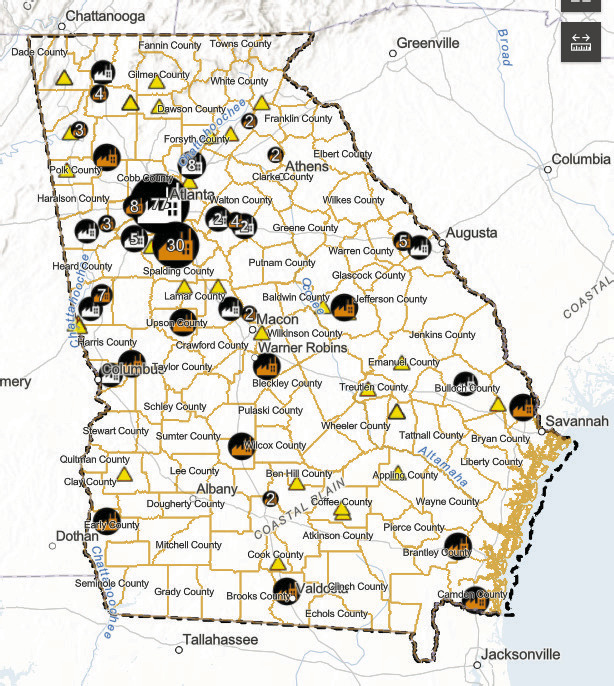
Cleanview reports that Georgia has 39 operating data centers with a combined capacity of 2,525 megawatts. Another 133 facilities are reportedly in development, which would add an estimated 16,366 megawatts of additional power demand.