
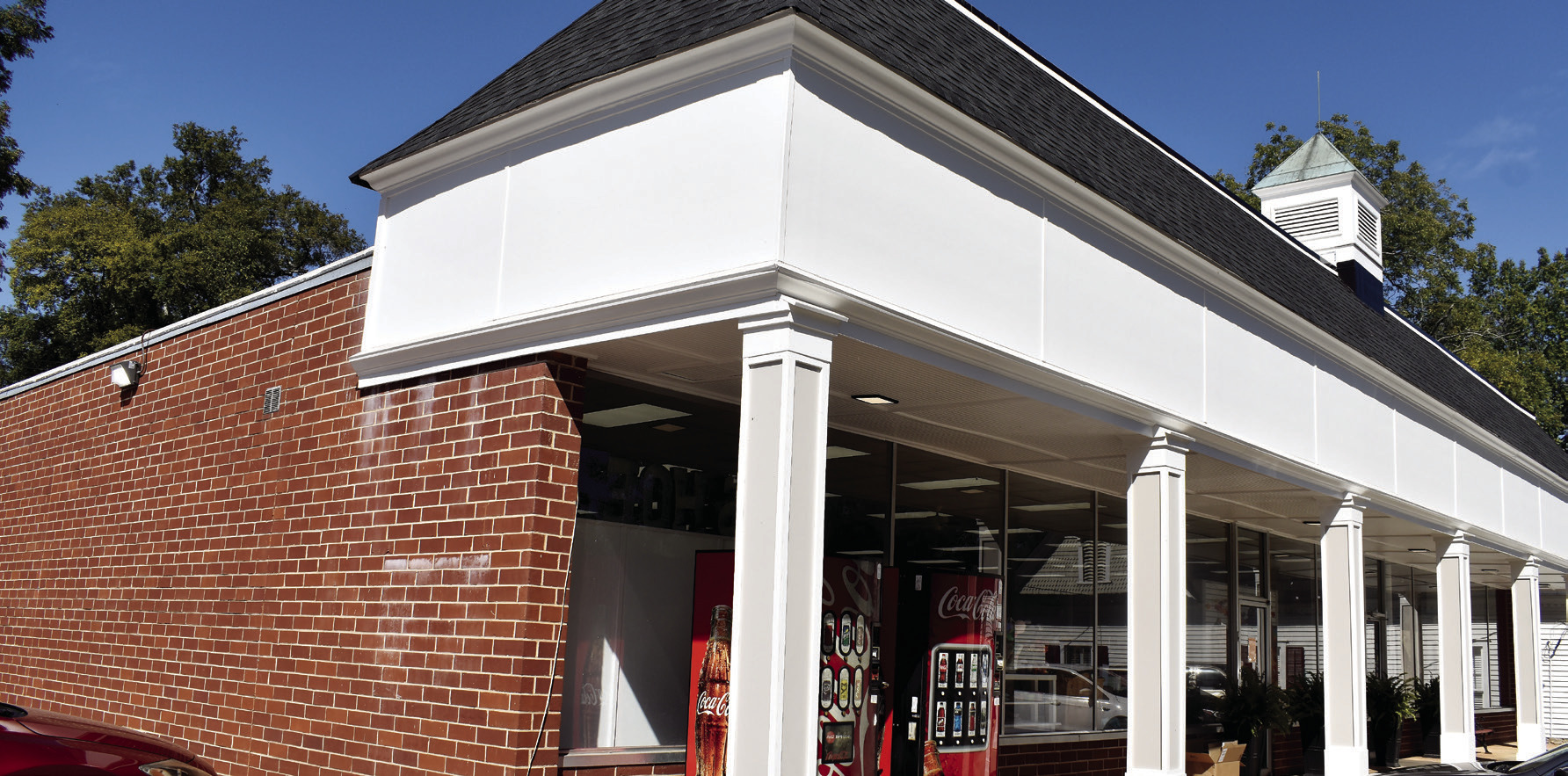
The Madison City Council upheld a ruling that denied the Madison Drug Company permission to paint the brick wall on the Thomason Street side of the building either white or gray.
Other changes to signage and lighting were planned, and some will be made, including black light fixtures and black signage.
Luanne Whetzel, representing the business, said the plain brick wall was an eyesore and wanted to change the colors to improve the aesthetics of the building, which would lead to more business and, by extension, more tax revenue for the city.
Madison’s Historic Preservation Commission ruled at its Aug. 13 meeting that the structure, which was originally a Colonial Store, was historically significant and rejected the Certificate of Appropriateness (COA) for altering the building. Zeb Grant and Jon Roby of the HPC voted against the denial of the COA.
According to the minutes of the HPC meeting, board member Chris Hodges said the commission’s focus is not on “pretty” but instead on historical context and significance.
“There are aspects of this building within the historical context that point to significance,” the HPC report reads. “Built during the early days of Madison’s awareness of the importance of design, it was touted that only three times had Colonial Store deviated from their basic store lines – Williamsburg, Old Salem, and Madison. Colonial officials agreed to deviate from their original architecture after a plea from local ladies representing the Beautification Committee, Historical Society, and Civic Design Committee. Colonial officials were widely praised locally for efforts and extra expenses.”
The building also illustrates the evolution of grocery stores nationwide and locally as the third iteration of Colonial Stores in Madison.
According to HPC guidelines, “paint color is not regulated, nor can it be under Georgia’s enabling legislation. However, design review covers painting (i.e., surface coating) for unpainted buildings.”
HPC staffer Ken Kocher said one of the earliest grocery stores in Madison was the Rogers, located on the corner of Main Street.
The Rogers store was located in the building now occupied by T.J. Bishop’s.
“Colonial Stores eventually bought out the Rogers store,” Kocher said. “In the ’50s, they built on Jefferson Street, which I think was the first iteration of self-service grocery stores, meaning that shoppers went in and got their own things instead of going in and having a clerk pick it all out and ring it up for them. As grocery stores evolved, that store on Jefferson Street really didn’t meet modern standards.
"They built the [Madison Drug] building in 1965. It had a lot of things we associate with modern grocery stores: a meat department, a produce department, that sort of thing. It did not keep up with other grocery stores; when the Piggly Wiggly was built down the street, the grocery store at that location closed.”
Kocher also said approval would set a bad precedent and allow other brick buildings from the same period to have the option of painting over brick.
Whetzel told the council that the denial of the COA made little sense to her.
She said other buildings in the historic district that were originally unpainted brick had since been painted and asked why they weren’t required to remove it.
Kocher responded that those actions were taken before Madison established HPC to protect historic structures.
Councilor Eric Joyce, who once served on the HPC, moved to deny the appeal, and Betsy Wagenhauser seconded it. The decision was unanimous.