
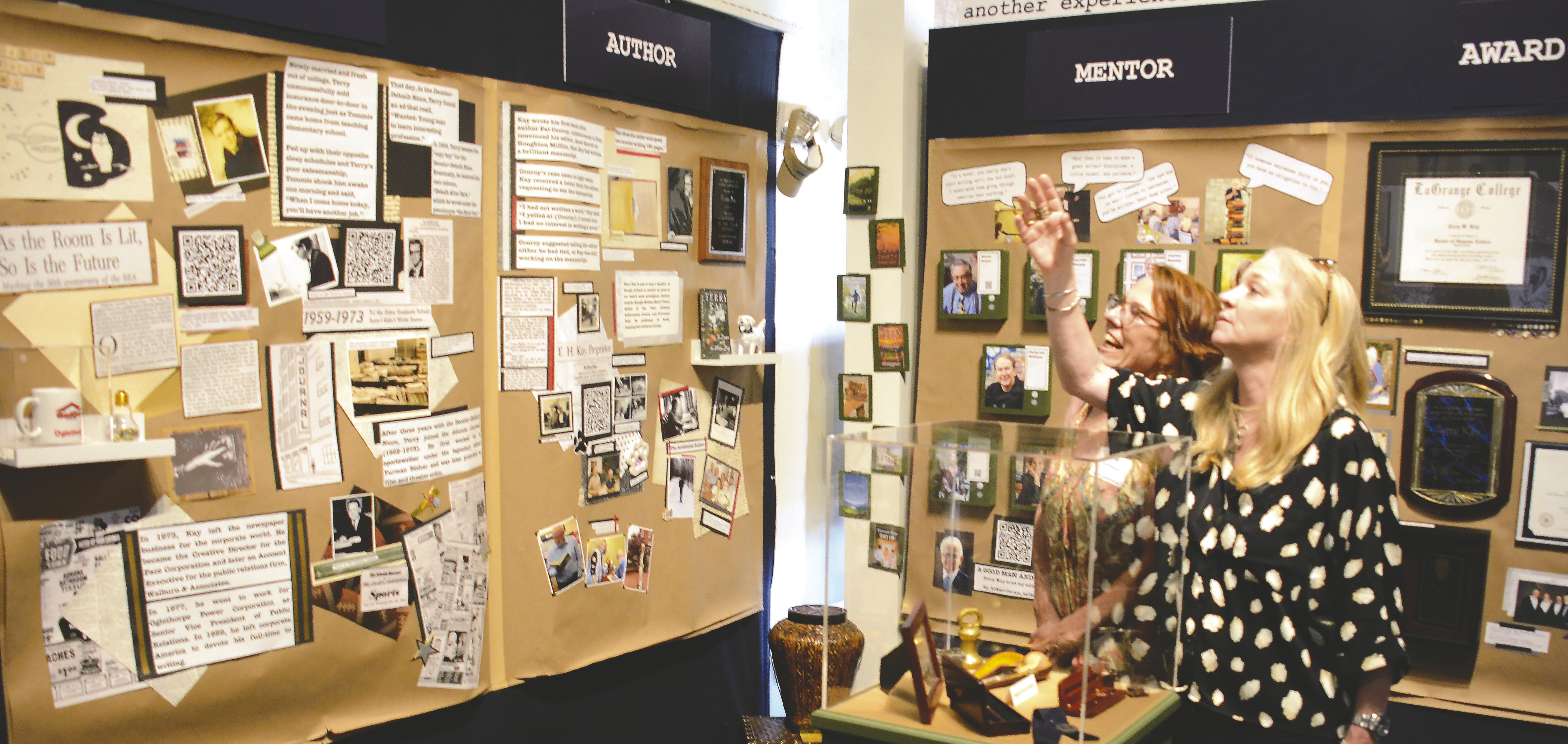


The Georgia Writers Museum in downtown Eatonton welcomed more than 60 lovers of the written word Saturday afternoon for the reveal of its newest exhibit featuring Terry Kay, who passed away nearly three years ago. The Kay exhibit officially opens to the public this Thursday.
Among the crowd was Kay’s high school sweetheart and wife of 52 years, Tommie Kay, as were all four of their adult children, John, Terri, Scott, and Heather, as well as the author’s older brother, John.
Tommie remembers the late-1960s when her husband received his first royalty check.
“I think we got $5,000 the first time for a book. And we thought we were rich,” she said. “But I mean, seriously, he never considered himself as belonging. He would always say, ‘I’m just not a writer.’”
Kay was born in 1938 and grew up in Royston the 11th of 12 children. After graduating from Lagrange College in 1959 he began selling insurance but soon switched to working as a copy runner at The Decatur-Dekalb News, where he eventually began his writing career.
By 1973 he was not only a published author but a sports reporter and film/ theater critic for The Atlanta Journal. That lasted until the early-‘70s when Kay left for a career in advertising before taking on a corporate public-relations role in 1977 that lasted 12 years until he became a full-time author.
Beginning in the late‘60s at the suggestion of his friend and famous Georgia author Pat Conroy, Kay eventually wrote 17 novels, three of which were adapted as movies, including 1990’s To Dance with the White Dog. That book eventually sold more than three million copies worldwide and earned Kay 1991 Outstanding Author of the Year honors from the Southeastern Library Association.
According to his Wikipedia page, Kay also won a Southern Emmy Award in 1990, the 2004 Townsend Prize for Fiction, and the 2006 Appalachian Heritage Writers Award.
His wife remains amazed at Kay’s literary production. She said most of his books were written in his spare time while also holding down a demanding full-time job as an ad executive and coming home to a house filled with four active kids.
“Most of his books he wrote while he had a job supporting us, and that’s hard to do,” Tommie said. “Sometimes he would go and spend the week off at a hotel and just knock out whatever he could and then he would come home and he would start writing again. He did that a good bit just because nobody would interrupt him and he could just sit there all day and all night if he wanted.”
The GWM Kay exhibit features not only Kay’s professional output but many mementos of his past, including personal items like his hat, a pipe, honorary degrees, and several family photos from all stages of his life.
“It’s overwhelming, incredible. They did a beautiful job,” Kay’s oldest daughter, Terri said, describing the wide array of day-to-day items on display that now represent her dad’s life and lifelong work. “This is all stuff that we grew up with and it’s special to us, but it’s just more special to be able to share it now.
“And I didn’t realize they were going to have the photos of different authors there with their experiences of calling him a mentor. I really thought that was nice because it gives a little context to his life beyond just, oh, he wrote this book and he sold so many copies and it got made into a movie and all that. They included the influences he had, so I really like that.”
Her mother agreed, though Tommie also admitted to feeling pangs of sadness when she first stepped into the midst of her husband’s belongings, essentially laid out in a timeline before her.
“They came over three different times and just looked through all of the stuff that we had in the storage unit to see if there was anything they could use. I knew they would take some of the books or a typewriter or something like that, but I really didn’t realize what they would do with it all,” she recalled. “But they’ve done such a beautiful job with what they took. I love it, but I felt kind of sad, too, because all of a sudden all the memories come back of all the things that we went through as he was beginning to be a writer.
"It just brought back lots and lots of memories, especially for the first few books because it was so new then and he never thought – we never thought – he worked at the paper and he wrote and did things like that, but we never thought that he would be able to be published or certainly be able to support our family with it. I love seeing it.”
The Georgia Writers Museum features free admission but accepts donations and also includes exhibits highlighting several other famous Georgia authors, including Putnam County’s own Alice Walker and Joel Chandler Harris, as well as a unique display of antique typewriters depicting how they developed over decades.
It is open Thursday and Friday from 10 a.m. to 5 p.m. and Saturday from 10 a.m. to 3 p.m. For tours between Sunday and Wednesday or for groups of 10 or more, visit online at georgiawritersmuseum.org to fill out a request form.