
PUTNAM COUNTY
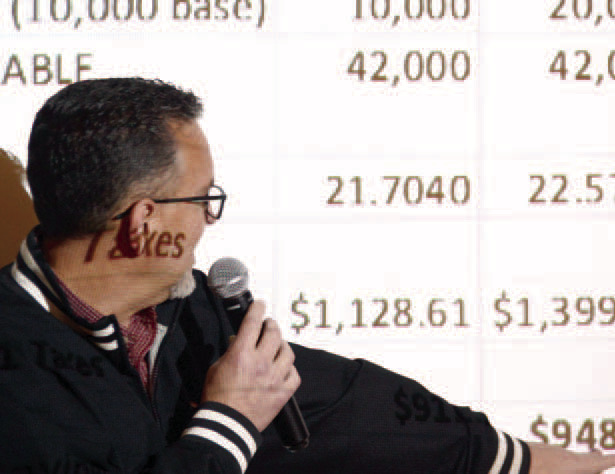
The Little Theater at Putnam County Middle School was abuzz with comments and complaints from about 60 local taxpayers on Dec. 6, as the Putnam County Board of Education hosted an information session about the ramifications of exempting senior citizens from paying school taxes.
The evening opened with a lengthy and thorough explanation by Chuck Anglin, chief appraiser for the Putnam County Board of Assessors on current tax requirements and the potential ramifications of multiple tax-change scenarios.
Anglin repeated several times he was not advocating for any option and was there just to explain how the county’s school tax system works, as several members of the Putnam school board, including Chairman Dr. Steve Weiner, sat nearby on the stage beside him.
Essentially, after presenting several complicated scenarios full of millage rates, homestead exemptions, assessed values and fair-market values, Anglin admitted even he had to sometimes recalculate to make certain he understood their effects. It all boiled down to bad news for those wanting to opt-out.
Be careful what you ask for; you just might get it.
Anglin didn’t utter those words, but through several mathematical examples, he made clear that any changes to the current tax structure in Putnam County would not automatically drop a senior citizen’s tax burden.
On the contrary, he said, if the education portion of current county taxes— about 75-80 percent of the total annual bill for most local taxpayers, which apparently is on the high end of typical in Georgia— were removed, whatever incentives or breaks associated with those education taxes also would be eliminated and the total bill may actually increase.
Board Chairman Weiner then spoke briefly about the distribution of Putnam County’s tax base, describing it as approximately 72 percent residential, which makes the property/school tax relationship that much more critical since there’s no significant business/ industrial alternative to turn to for alternate funding. Regardless, he added immediate relief for seniors would not be available.
“The only way we can change the tax structure is by local legislation,” Weiner explained. “It could take anywhere between one and two years depending, but it isn’t something that’s going to happen tomorrow. The system doesn’t allow that.”
He also pointed out if all county seniors were exempt from paying school taxes it would cost the school board approximately $2.5 million in annual revenues, “which would have to be made up by other taxes.”
Once the floor was opened to public comment, it soon became obvious some people were advocating for an outright elimination of school taxes for everyone 65-70 years old and over, while others envisioned a sliding scale that takes into account property values and personal assets.
Vincent Mallardi, who said he is a retired economics professor, pointed out the obvious financial difference between Putnam County seniors who may own a 300-acre horse farm or live in a big lakeside home versus those living in low-income neighborhoods in small houses on 40- by 100-foot lots.
“They’re the ones that obviously need the most help,” Mallardi stated. “We are talking about people that don’t use the schools and have lived here a long time and may be forced to leave the county because of the high school taxes, and if they leave the county, you’re going to have to reposition all these ratios in any event.”
One woman in the audience appeared close to tears as she described how she and her husband had specifically chosen Putnam County as their retirement destination, but she now feels ready to move away.
“I’m not trying to be ugly, but it feels like robbery, what you’re doing to us,” she said. “We came here to retire on a fixed income and when we got the first school tax bill—I’m not even fussing about the property taxes—I’m fussing about double what my property tax is. It’s horrible and it feels like robbery.”
Not everyone was even focused on the dollars and cents of a tax bill.
For many, the issue at heart is Putnam County’s school system consistently being graded among the worst in the state despite having a higher-than-average expenditure per student compared to other counties.
Weiner countered by explaining the State Department of Education and the Putnam County school system disagreed three years ago about a procedure that allowed all Georgia parents to exempt their children from taking state tests.
“Thirty percent of our parents chose to exempt their children from state tests in 2019. The State Department of Education chose to count those 30 percent as zeros rather than the test scores achieved by the children,” Weiner said. “So, the 2019 rating was lowered by something like 20-odd percent, which would have put us in the top 20 or 25 percent in the system.”
The evening ended much as it began, with frustrated citizens and a school board apparently left with few obvious options to the status quo. And questions, so many confusing questions.