
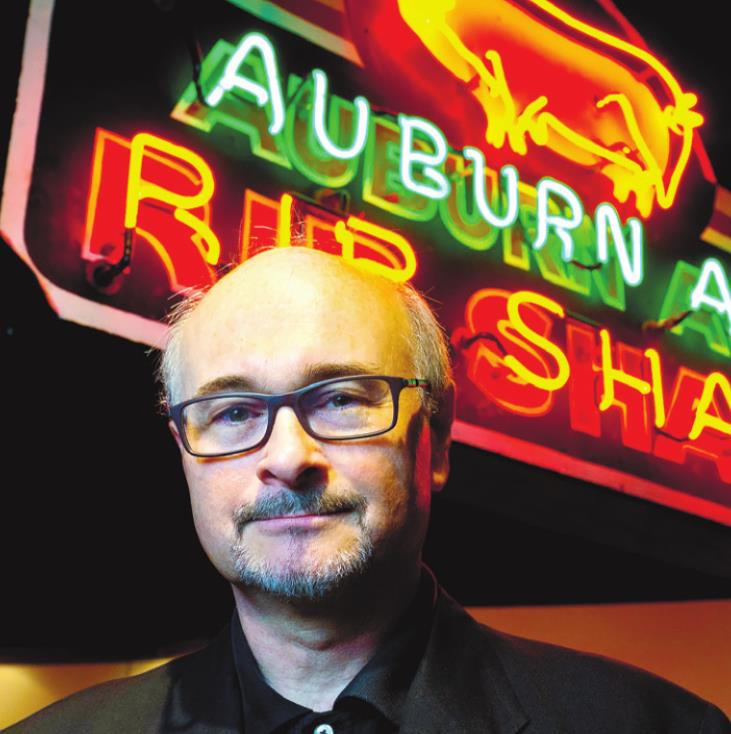
"Barbecue, Beer, Books, and Band” will be the Georgia Writers Museum “Meet the Author” event featuring Jim Auchmutey, to be held on Saturday, May 7, at 6 p.m. at The Edgewater on Lake Sinclair, the newest addition to Oconee Springs Park, located at 109 S. Spring Rd, Eatonton. Jim will talk about his book, Smokelore: A Short History of Barbecue in America. Barbecue will be furnished by Fresh Air Barbecue in Jackson; music will be provided by The Tom Hill Trio, featuring Annette Harris Shakespeare, great-great-granddaughter of Joel Chandler Harris. We caught up with Jim this week to get a quick preview of the upcoming 4Bs Bash.
You say that barbecue is the most American of foods. Why?
Barbecue involves almost every ethnic strain that makes up this country and has been present at every stage of our history. It was so well-established by the time the United States was founded that they held a barbecue to celebrate the laying of the Capitol cornerstone. Why do you think so many people mark the Fourth of July with a barbecue? It’s the American thing to do.
Did Americans invent barbecue?
Not really. People have been smoking and grilling meat since our ancestors lived in caves. Almost every culture in the world has some version of barbecue. But the New World take on it—especially the barbecue traditions rooted in the Caribbean and the American South—are unique and powerful. I can’t think of another country that cherishes barbecue as much as America. Maybe Australia— but what they do is really grilling.
So you agree with the Southern distinction between barbecue and grilling?
People who write about barbecue get tired of pointing out that low and slow cooking over an indirect fire is barbecue, and quick-cooking steaks and hamburgers over a direct fire is grilling. It seems self-evident. But if someone in Sheboygan wants to grill a brat and call it barbecue, I think we can be ecumenical about it. It’s all rock ’n’ roll to me.
What is Georgia’s place in the barbecue firmament?
Georgia used to loom much larger in barbecue consciousness than it does now. Until about World War II, when people referred to barbecue, they usually meant a big event like a political rally or a plantation barbecue like you see in “Gone With the Wind.” Georgia was identified with those and was often referred to back then as the capital of barbecue. Nowadays we think of barbecue as a restaurant or backyard cooking, and other places like Texas, the Carolinas, or Memphis and Kansas City get most of the attention. Georgia is the buckle of a pork barbecue belt that runs from Virginia to east Texas, and its ’cue isn’t much different from most of that region. The most distinctive thing about Georgia barbecue is probably Brunswick stew. Nowhere else is stew as likely to be a standard part of a barbecue plate.
Don’t miss the 4B’s Bash. Tickets are $25 each and going fast. Contact Georgia Writers Museum or www.georgiawritersmuseum.org.
- Contributed