
On one of the walls in the north hallway at the Plaza Arts Center hangs a photograph – and with it, one of my favorite stories to tell visitors to the Old School History Museum.
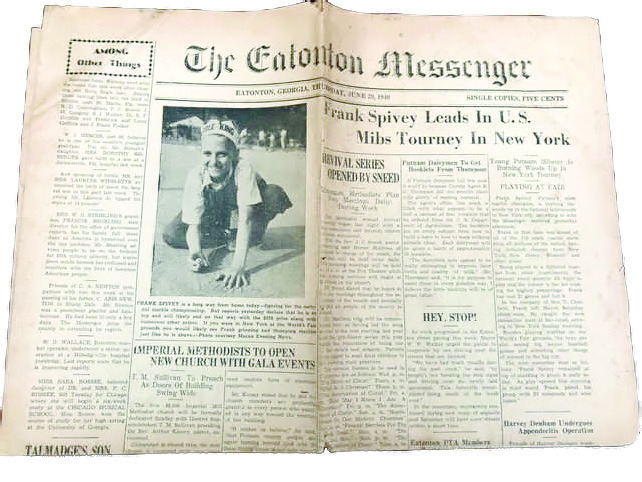
The photograph features a boy smiling and looking upward while down on one knee and with one hand on the ground, stretched forward. The boy is wearing a goofy “Marble King” beanie, a cap somehow popular among the younger set in the 1920s and ‘30s.
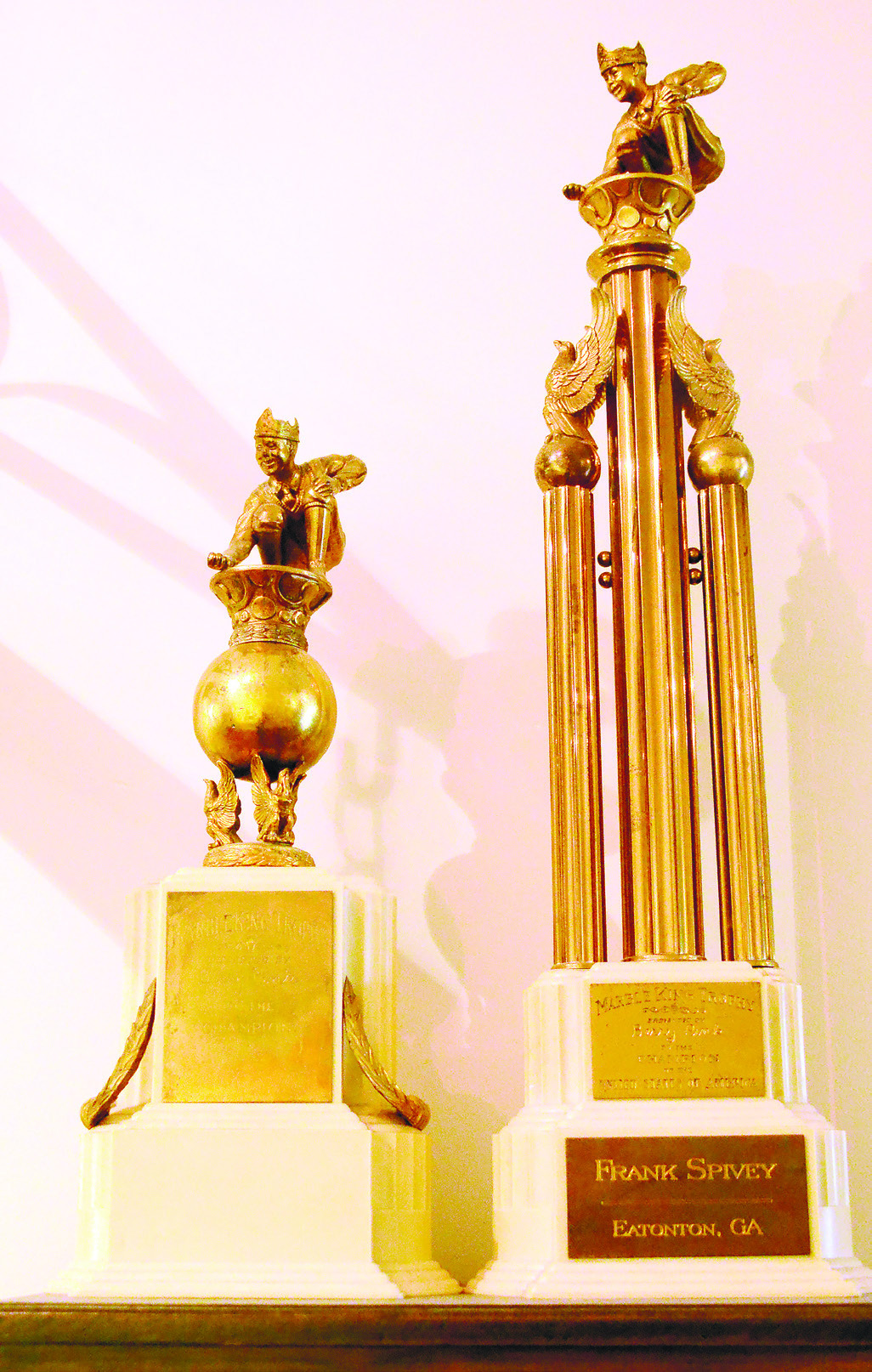
On a shelf above the photograph sits two aging but still imposing trophies. One is perhaps 24 inches tall; the other is even taller, perhaps 30 inches. Atop each trophy rests a small brass boy in the same pose as the boy in the photograph below them.
The boy in the photograph is northeast Putnam County’s own Frank Spivey, at about age 10 or so. He is playing a game, usually just called “marbles” or “shootin’ marbles.”
He is in the photograph – and the photo and two trophies are on the wall – because in 1939 young Spivey went to Macon and won a state marbles championship in a boys’ tournament. One of the prizes was a trip to New York City to compete on the national stage.
And Spivey won the national tournament, too, in part because his “trick shot” could make his taw spin backward and stop in its tracks when it struck another marble, much like a good pocket pool player can make a cue ball come to rest where he wants, in order to set up the next shot.
State champion. National champion. Now, the corporate sponsors of the 1939 tournaments may have had some written rules, but as a boyhood pastime, there were no written rules.
Like many other childhood games, boys “just knew” the rules.
The object of the childhood boys’ game was fairly simple, albeit with some subtle competitive overtones that might last into adulthood.
Two boys would draw a circle of indeterminate size in the dirt, sometimes just a couple of feet in diameter, sometimes much larger, depending on the bravado of the players. The surface was preferably sandy and level.
One boy would drop an agreed number of colorful glass marbles – usually 10 to 15 – from his stash into the circle. The stash was his collection of marbles, sometimes bought at a store but preferably won in combat.
The second boy – the “shooter” – would start the game by bending down and putting his shooting hand on or close to the ground on the outside of the ring. On his forefinger, he would place his favorite marble (called the “taw” for God-knows-what-reason) to be flicked with his thumb toward a marble inside the ring. The skill came from the power of the flick and control of the aim.
If the shooter hit a marble and it went outside the ring, he got to collect the opponent’s marble. If no marble exited the ring or he simply missed, well, the opponent got to shoot. And so on until all the marbles in the ring were accounted for, and then the roles reversed.
Now comes what Paul Harvey used to call “The Rest of the Story” on his old radio show. Young Frank Spivey indeed was the Georgia state marbles champion in 1939, and shortly after, he won the national marbles championship, competing against boys from all across the United States.
However, he was never the Putnam County champion. According to Maude Hicks, who knows more than a few passed-down local tales, the starting point for the whole adventure came in a face-off between Spivey and another 10-year-old, Gus Lankford, in the little local tournament. Both Spivey and Lankford were quite good, but Lankford won the Putnam tournament, with Spivey coming in second.
Lankford grew up in the Lower Harmony Road area in a family with 10 siblings. Putting food on the table for 13 meant a lot of daily chores. Saturdays especially were all-hands-on-deck affairs – certainly not meant for going to Macon for a marbles tournament. So Spivey took young Lankford’s place, and we all know “the rest of the story.”
Spivey passed away a few years back, but come the first week in May, Lankford will celebrate his 93rd birthday. So, herewith, comes an early happy birthday wish for Gus Lankford and recognition for what might have been.