

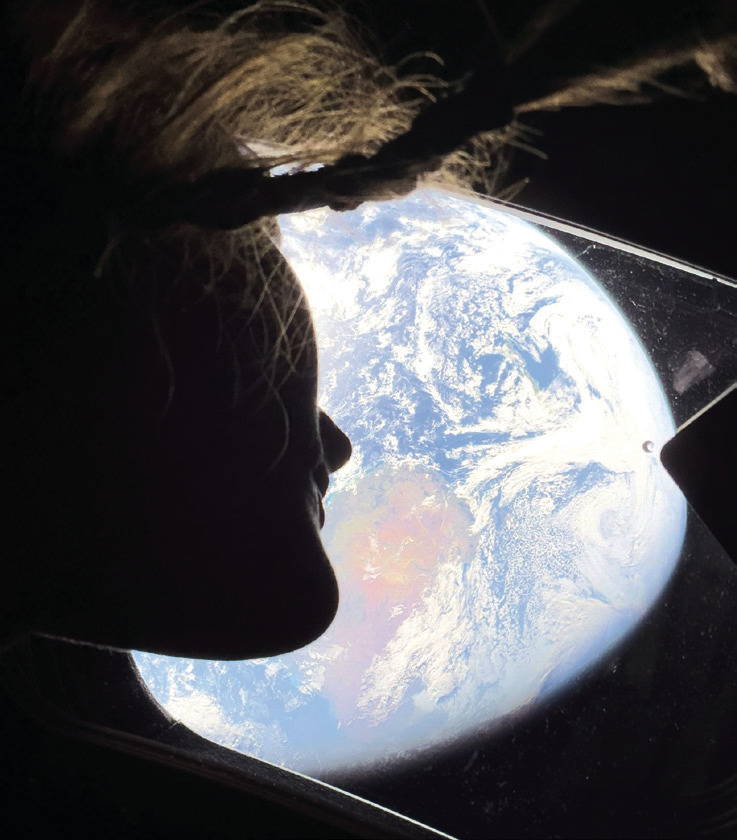
I keep thinking about how far away they are.
Literally as I write this, four astronauts aboard NASA’s Artemis II mission will travel farther from Earth than any human beings have ever been before, peaking at 252,756 miles away as the crow flies. Within 10 minutes, they will slip entirely behind the moon, where not even radio signals can reach them, where they will be well and truly alone for about 41 minutes.
Yet, as sentient, caring beings, they somehow feel closer than ever to us.
There’s something about this mission, this quiet, deliberate, some might say risky return to deep space after more than half a century, that lands differently for the United States given its current role on Earth.
There will be no moon landing for Artemis II, no planting of flags, no triumphant return to lunar presence. This time at least, it is “just” a flyby, just a test, just a quarter-million-mile trip culminating in one long arc across Pink Floyd’s Dark Side of the Moon before heading back home.
Delivering a pause, almost, before immediately resuming course back toward Earth, toward safety, toward home.
Meanwhile, unfortunately, there is no pause to what’s going on while these brave souls demonstrate the absolute best of the U.S. to the rest of the world (with one Canadian aboard).
Headlines that compete with glowing Artemis II coverage remain jagged and angry, filled with bitterly partisan politics, armed conflict, and fears of overseas escalation. Only uncertainty, the looming presence of potential for disaster, appears as the lone common denominator.
The United States is locked once more in a cycle that simultaneously feels familiar, yet frighteningly new. The language is sharp, mean-spirited, threatening, and vengeful, but the real-world stakes remain very human. But unlike what we all hope for our astronauts, no one at war is likely to enjoy a pleasant trajectory home.
That contrast is hard to ignore.
On one screen, we can watch the Orion capsule drift past the lunar surface, its crew catching glimpses of terrain no human has ever directly seen illuminated before. On another, we follow maps of conflict zones, red markers multiplying, each one representing life interrupted, or ended.
It is, in one way, dissonant, but in another, deeply human. Because if Artemis II provides us with anything, it is not escape; it is perspective.
These astronauts — Commander Reid Wiseman, Pilot Victor Glover, and Mission Specialists Christina Koch and Jeremy Hansen — aren’t leaving Earth behind so much as they are carrying it with them. Every system they test, every photo they take, every silent moment behind the moon is completed in full expectation of safely returning home.
That’s the part that stays with me. Even at the farthest distance humanity has ever reached, the mission’s success will ultimately be defined by its return.
It seems ironic that the same nation capable of sending humans farther into space than ever before is equally capable of re-entering cycles of violence and death and destruction as old as history itself.
Our country’s greatest scientific minds can calculate trajectories with astonishing precision, can guide a spacecraft around the far side of the moon, and back to a pinpoint landing in the Pacific Ocean. However, we repeatedly and painfully struggle with charting a course toward lasting peace.
It’s easy, even tempting, to see Artemis II as a reminder that we are more than our conflicts suggest, which is true, of course. Space flight provides real-world testaments to technology, engineering, cooperation, training, and the stubborn belief that exploration still matters.
But the same ingenuity that built a launch-and-retrieve system to carry astronauts to the moon safely and back exists alongside the technology and knowledge to wage war, well capable of striking targets literally half a world away. And that contradiction is not abstract; it’s structural, very real.
So, the unavoidable question: how do we live with that duality?
Watching Artemis II, I don’t feel pride so much as I feel tension. Awe, certainly, but there’s frustration, too. Maybe call it a quiet unease. Because the lunar mission reminds all of us of just what America is capable of at its best, even as the daily news also reminds us of what we are capable of at our worst.
So, I keep coming back to that image of the spacecraft slipping behind the moon, communications cut, the crew absolutely alone for a brief stretch in perhaps the deepest quiet humans have ever known.
Forty-plus minutes literally cut off from all snippets of civilization, barring that which remains within their relatively tiny craft. No headlines, no orders, no instructions, no escalations. Just distance to cover before ultimately, inevitably, returning into view. Signal restored, voices returned, connection reestablished.
If only it were that easy here on Earth. Unfortunately, it still feels like a choice we haven’t quite learned how to make.