
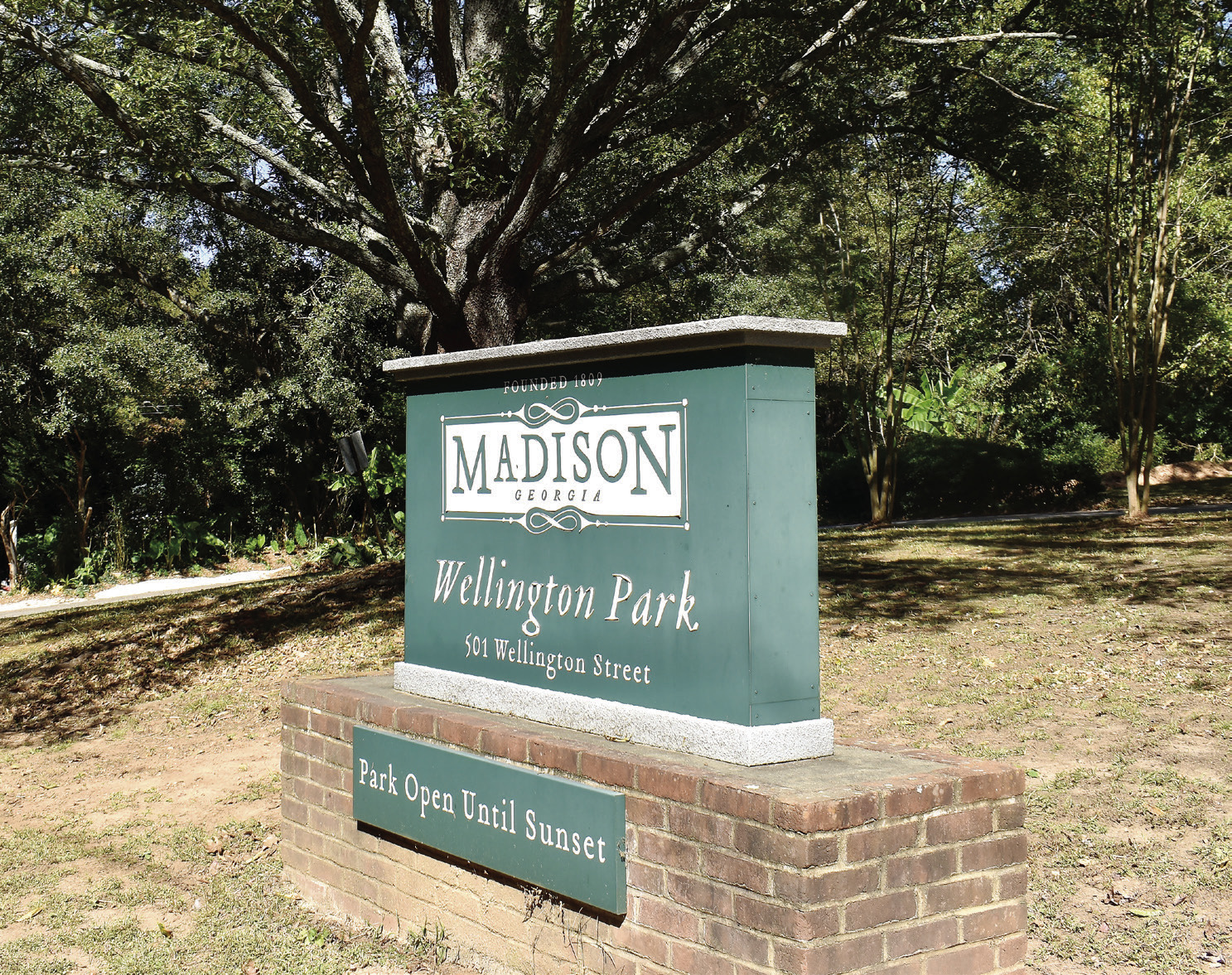
Whether you were among those who knew it as Black Top or those who knew it as Wellington Park, the city park on Hwy. 83, just north of Madison Town Square, will henceforth be known as Rodney Andrews Park in honor of the late scholar and Madison native.
The Madison City Council agreed to the new appellation on Oct. 14 following a lengthy discussion of Andrews’ legacy and his local impact.
Reverend Aaron Carter of the Rodney Andrews Memorial Committee opened the discussion with a presentation detailing Andrews’ accomplishments.
Carter said Andrews was a 1994 Morgan County High School graduate who received a PhD in economics from the University of Michigan and studied at Harvard University as a Robert Wood Johnson Foundation scholar. Carter said Andrews was one the most respected African American scholars in the economics field.
Andrews was a professor of economics in the School of Economic, Politicaland Policy Sciences and director of the Texas Schools Project University of Texas in Dallas.
According to the UT Dallas website, Andrews investigated a range of topics, including health policy, public finance, and labor economics.
The website says that Andrews received 21 grants totaling $1.9 million as a principal investigator at UT Dallas. “His scholarly work was supported by the Laura and John Arnold Foundation (now Arnold Ventures), the Bill & Melinda Gates Foundation, the Greater Texas Foundation, the Smith Richardson Foundation, and the Russell Sage Foundation.”
Andrews died in Plano, Texas, on May 12, 2023, at 47. A Celebration of Life was held at Union Springs Baptist Church in Rutledge.
“He was a role model who understood the challenges he faced and was always ready to offer guidance and support,” Carter said. “He lived in Texas but remained connected to his roots in Madison and frequently visited. He was more than a brilliant scholar, he was a symbol of perseverance, hope and achievement. His life and legacy deserve to be recognized.”
Carter then showed the council a petition signed by more than 500 people.
Local pastor Anthony Williams, a graduate of MCHS and childhood friend of Andrews, said Andrews tutored many local children and adults and never sought accolades for it.
Williams cited a passage from Matthew 6 in the Bible to illustrate his point: “Be careful not to practice your righteousness in front of others to be seen by them. If you do, you will have no reward from your Father in heaven . . . But when you give to the needy, do not let your left hand know what your right hand is doing, so your giving may be secret. Then your Father, who sees what is done in secret, will reward you.”
Williams closed out his remarks with this analysis of Andrews’ worthiness: “Does he deserve it? No – he deserves more.”
City Councilor and Mayor Pro-Tem Carrie Peters-Reid left the council and joined the assembled crowd in the council chamber as a gesture of support.
“Rodney was an amazing man,” Peters-Reid said. “Not just to people in this city but around the world. This isn’t just about Rodney; it’s about the people behind Rodney, the boys and girls at Morgan County High School, who will see something named after an African American male in the city.”
Madison resident Jay Doss, who serves as the assistant director of the Putnam County Recreation Department, is also one of Andrews’ contemporaries.
“Rodney shows every kid in this county that you can succeed and go far, and it doesn’t have to be based on your athletic ability,” Doss said. “Rodney personally helped me get my degree after I got out of the Army. Y’all would be doing a tremendous honor to this man.”
According to City Attorney Aaron Wadley, a policy for naming city facilities was developed in 2010, when Bruce Gilbert was mayor.
The policy dictates that individual names to be considered for use on public facilities must be natives of Madison or closely associated with the city or county. Andrews checked that box because he was a native, and he demonstrated exceptional service to the city and inspired others. The policy also required that a person being considered must have been deceased for a minimum of five years, which would have disqualified Andrews since he died in 2023.
Councilor Eric Joyce said he believed the park’s historical significance belonged to the Black community in Madison (it was once known as Black Top in the Black community).
“For me to decide what that park should be named would be presumptuous,” Joyce said.
“I think we can all agree [Rodney] did great things in his life,” Perriman said. “I think we need to get something in place after tonight.”
Councilor Ed Latham then moved to strike the policy requiring a five-year waiting period between death and naming a facility.
After that passed, he made a motion to name the park after Rodney Andrews. It was unanimously approved, followed by applause.
Councilor Betsy Wagenhauser summed up the mood: “We work so hard to try to involve the African American community in a lot of what we do. I couldn’t imagine that we could do anything but agree with what you wanted. Just to send a signal that we support you.”
The park was originally named after Wellington Street, which extends from Washington Street after its intersection with Jefferson Street.