
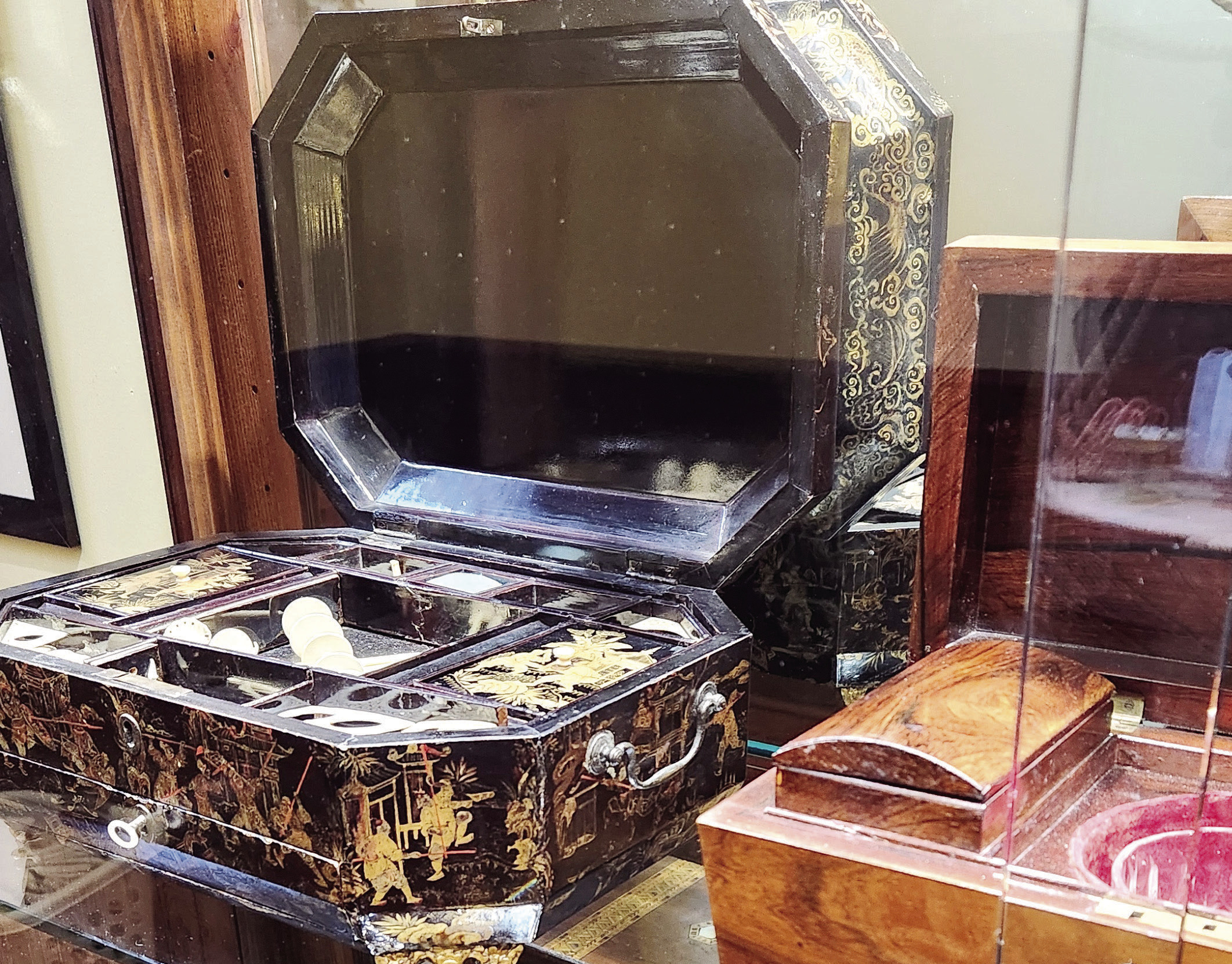
Have you ever heard of Tunbridge Ware?
Years ago, Rosemary Buttermore saw her first piece and marveled at the design and the skill it took to create it. The boxes were intricately decorated using a technique known as Tunbridge Ware which is a type of decorative veneer work that originated in the town of Tunbridge Wells, far southeast in Kent, in England during the 18th and 19th centuries.
In the early days, the Royal Court used to come to the area to escape epidemics. These boxes are highly desired for their age, historical significance, design, and craftsmanship, and most of the boxes on display are from the reign of King George III and IV, very early examples.
Early makers of Tunbridge Ware, in Tunbridge Wells in the mid-18th century, were the Burrows family, and Fenner and Co. But the most collected pieces are from a later period - 1830 to 1900. In 1830, James Burrows invented a technique of creating mosaics from wood tiny tiles.
Henry Hollamby apprenticed to the Burrows family, set up his shop in 1842, and became an important manufacturer of Tunbridge Ware, employing about 40 people. Then two other craftsmen, Edmund Nye (he and his father bought out the Fenner Company) and Thomas Barton, created a workshop named “The Chalet”. Today in Tunbridge Wells, there is a plaque commemorating both Nye and Barton placed next to the door of their workshop “The Chalet.”
The town of Tunbridge Wells was a popular spa town that attracted many tourists. Tourists were eager to take home a souvenir of their vacation and the little wooden boxes made a perfect gift for themselves or others. Besides boxes of all sizes, other items such as cribbage boards, paperweights, writing slopes, and glove boxes were all popular choices.
Here are some characteristics of an antique Tunbridge Ware box:
• Material: Antique Tunbridge Ware boxes are typically made from hardwood, such as rosewood or mahogany, which provides a solid foundation for the decorative veneer work.
• Veneer Design: The distinguishing feature of Tunbridge Ware is the intricate mosaic- like design created by arranging thin strips of different colored woods, such as maple, yew (which changes colors four times a year), oak, rosewood, and satinwood, to form geometric patterns, floral motifs, or scenic landscapes. The veneer pieces are carefully cut, shaped, and assembled to create a visually stunning effect.
• Hinged Lid: Tunbridge Ware boxes often have a hinged lid that opens to reveal a compartment for storage. The lid may feature a decorative veneer pattern that continues from the box’s exterior.
• Interior and Lining: The interior of an antique Tunbridge Ware box may be lined with fabric, velvet, or silk to protect and cushion the items stored within.
Some boxes may also have dividers or removable trays to further organize the contents.
• Labelsor Markings: Some Antique Tunbridge Ware boxes may bear labels or markings indicating the maker, retailer, or origin. These labels can provide valuable information about the box’s history and provenance. The manufacturers of Tunbridge Ware were cottage industries and were no more than nine in Tunbridge Wells and one in Tonbridge. The number declined in the 1880s. Competent craftsmen were hard to find, and public tastes had changed. After the death of Thomas Barton in 1903 the only surviving firm was Boyce, Brown, and Kemp, which closed in 1927.
Antique Tunbridge Ware boxes are highly sought after by collectors and antique enthusiasts due to their exquisite craftsmanship and unique decorative technique. They are valued for their intricate designs, vibrant colors, and connection to the Tunbridge Ware tradition. These boxes represent a specific period in English decorative arts and continue to delight collectors, like Rosemary Buttermore, from all over the world.
This exhibition can be seen from Jan. 2 to March 30 in the main hall of the Madison Morgan Cultural Center. The Cultural Center is open Tuesday through Saturday from 10 a.m. to 5 p.m.