
There’s plenty of old-school influence around Eatonton and Putnam County, but none so literal as the Old School History Museum in the south wing of The Plaza Arts Center on Madison Street.
Originally, the “Old School” of the current museum was the new school for the county after a devastating fire in January 2016 consumed the original Eatonton School. Local residents quickly rallied and hired Methodist minister turned architect Charles Choate to design a new house of learning for them. Remarkably, the new structure was designed, built and occupied by year’s end.
Several generations of Putnamites passed through the new Eatonton School over the next few decades, through World War I, the Great Depression, World War II, the atomic age, and into the Summer of Love, disco days and the dawn of the electronic era. By the late ‘70s, though, new separate schools were built for local primary, middle and high school students, while the “new” Putnam School pivoted to become a home for Head Start programs and later an early childhood development center.
By the end of the ‘80s, the school building was mothballed and inevitably began slipping into disrepair.
Beyond further decay, nothing much changed for another decade until Tom Rosseter, a relative newcomer to Putnam County in 1997, toured the rapidly deteriorating structure and saw what no one else had in many years: potential.
“The ceiling was coming down and the windows were out, and everything was terrible,” Rosseter said in a video made about the school’s resurrection as a museum. “But the whole area, the whole room, they don’t make rooms like these anymore. It was something. All I could say was, ‘Wow, this was a great facility!’ But it was falling down.”
Rosseter spearheaded the effort to rescue and restore a part of Eatonton’s history that to this day represents a significant, important part of several elderly residents’ lives.
Martha Adams will be 93 in November and remembers her school days well. In June this year, she described sitting in the same room that now houses a mini replica of Eatonton’s downtown core, taking grade-school notes and paying close attention to her teacher.
“You had to back then,” Adams said. “School was a serious place. Of course, we had fun, too, but we were there to learn, and our teachers made sure we knew that. But yes, we loved it here. It was a great place.”
According to the restoration video, Rosseter convinced then-Mayor Billy Dabbs to get on board with the school restoration project. Dabbs in turn appointed Eatonton councilmember Ulysses Rice to help move things along.
Rosseter credited Rice, who died in 2005, with being “a big influence” in getting the local community on board with the project, which saw the former school building being turned into a first-class arts and culture center anchored by what is now The Plaza’s 500-seat theater where the school’s auditorium once stood.
Overseen by Rosseter, three committees were formed for the overall project, led by Dottie McClain in the auditorium, Maude Hicks in the museum, and Marsha Sichveland for the landscaping of the large entrance lawn.
“We wanted something that would be a gathering place, where people would come with families,” Sichveland said.
Money for the project came from the Eatonton Putnam Arts Foundation (EPAF), government grants and voted-in SPLOST taxes, but mostly by generous contributions from many local businesses and individual citizens. All told, the restoration of the school and its conversion to an arts venue and museum totaled approximately $2.5 million.
“It was a challenge to convince people that we needed to put that much money into the school to make this building a reality, and to convince them that it was not just a citywide project, but it would benefit the whole county,” present Eatonton Mayor John Reid recalled in the video.
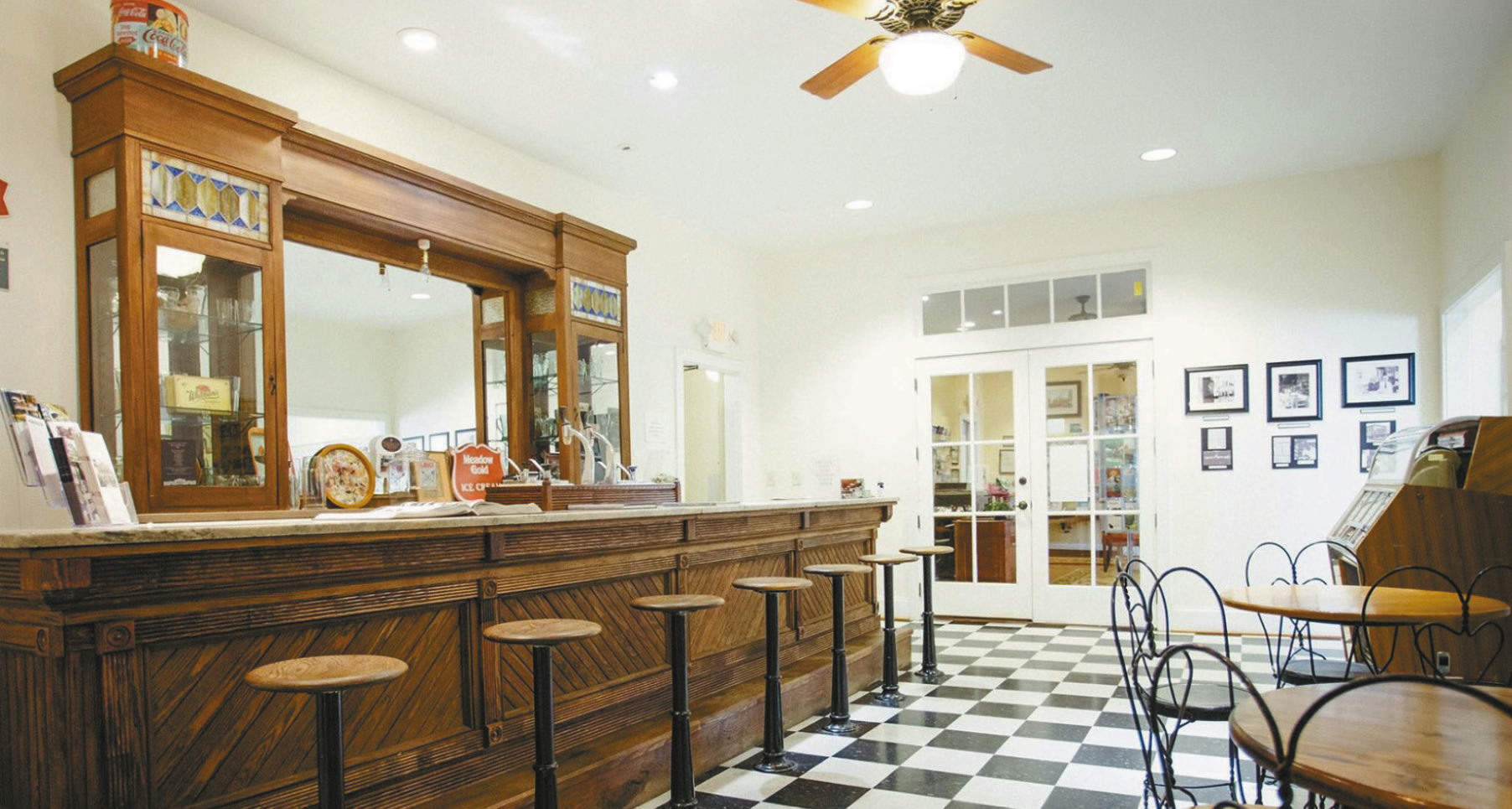
The museum itself is housed in what once were four classrooms, with visitors entering through what is now a recreation of a mid-20th-century drugstore soda fountain, complete with rotating stools and the marble-topped counter and cabinetry that once served Putnam County teens out on a Friday night date. The room also features a 1940s jukebox, with framed black-and-white photographs on the walls providing visual testimony of what bygone eras of Eatonton looked like.
From there, visitors pass to the next classroom for a small sampling of recreations of Old Eatonton’s downtown storefronts, including the recreation of a ticket booth to the still-standing Pex Theater, a small department store, and the barber shop that once filled the same space at the corner of North Jefferson Avenue and East Marion Street that The Eatonton Messenger now occupies.
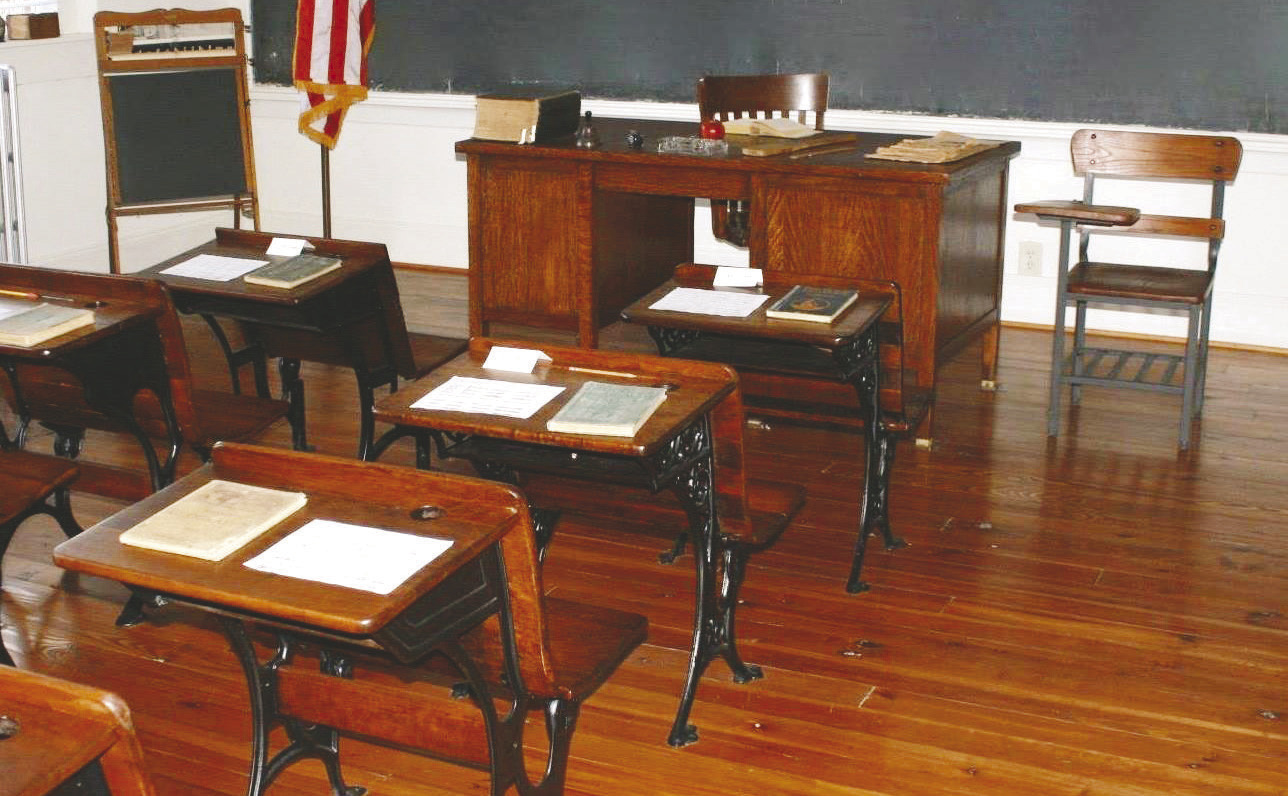
The third classroom presents several artifacts and information about a mixture of Native American, frontier, Civil War, reconstruction, and 20th-century history for Eatonton and Putnam County, while the fourth is most true to its original purpose with antique student desks and teacher’s desk, plus a blackboard and cloakroom original to the building.
The Old School History Museum (305 N. Madison Ave., Eatonton) is closed on holidays but typically opens Monday to Thursday from 8 a.m. to 4 p.m. for self-guided tours, and for docent-led tours on Fridays from 10 a.m. to 2 p.m., and Saturdays from 10 a.m. to 4 p.m.
Appointment-only Sunday reservations may be available if arranged at least 24 hours in advance by calling 706-923-1655. Admission is free but donations are always greatly appreciated.