
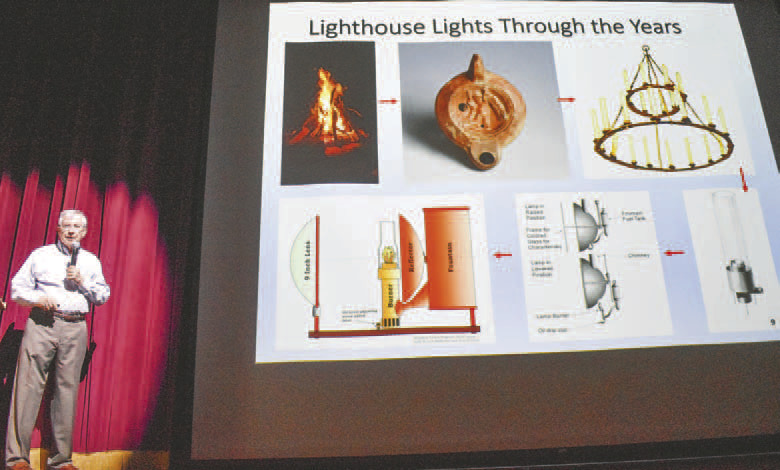
Dr. William Rawlings presented a lecture on Oct. 9, shedding light on the history of lighthouses in Georgia as part of the Sunday at the Museum series at Eatonton’s Old School History Museum.
“It helps us to keep the museum going and to bring in outstanding speakers and outstanding exhibits,” Old School History Museum Director Sandra Rosseter said.
Rawlings gave a wide-ranging summary of his latest book, Lighthouses of the Georgia Coast, and described the history of lighthouses in general, how they changed over time, their role in the Civil War and the lives of lighthouse keepers.
Born, raised, and living in Sandersville, Rawlings is a retired physician who specialized in internal medicine. He was educated at Emory, Tulane and Johns Hopkins Universities.
Lighthouses represents his 11th book and his fifth work of nonfiction.
“My family has lived in the same town for more than 200 years, since the 1790s,” he said, telling what sparked his interest in history. “You grow up in the household with all the family documents … I have always liked lighthouses. The opportunity to write about them in the context of this being part of Georgia's history was wonderful.”
Rawlings stressed that to understand Georgia lighthouses or any lighthouse, it’s important to first know a little about the basics.
“Many people think that they were built to save lives, but the truth is they were built for economic reasons,” he revealed.
According to statistics Rawlings provided, the number of lighthouses and navigational aids in the U.S. (lightships, lighted buoys, fog signals, bell and whistle buoys, other buoys and minor aids) had grown from 45 in 1790 to 14,947 in 1916. He mentioned how the invention of the Fresnel lens “completely changed the world of lighthouse illumination.”
Then he suggested, “If you don't know what this is, look at your car. You've got several.” Additionally, “the best-known lighthouse keepers were not men,” he said.
“You think of some groggy old guy with a beard, who lives in this strange place and doesn't see human beings. But the best lighthouse keepers were women.”
He then told stories of Grace Darling and Ida Lewis, heroines of their time, who rescued people after shipwrecks.
Rawlings also revealed little-known facts about lighthouses during the Civil War. The reasoning behind the secession of the South, according to Rawlings, was the fact that “we've got all the money.”
So, when the war broke out in 1861, the first logical thing to do was to block the South from access to money and, consequently, to arms.
“President Lincoln instituted a blockade of the South that supported the Confederate cause. By about 1860, the United States Lighthouse Board had the best orderly system of coastal beacons in the world,” Rawlings explained. “Paradoxically, the Confederate States Lighthouse Bureau presided over the dismantling of all the lighthouses in the South (in order) not to give the northern blockade ships guidance in waters unknown to them.”
Rawlings also told the story of each of the five still-existing lighthouses on the Georgia coast: Tybee, Cockspur, Sapelo, St. Simons, and Little Cumberland Lighthouses. “We’ve been to most of the places he was talking about,” said Judy Carman. “More than once,” added her husband, Bill. “Gone fishing there all the time.”
“It’s just so unique,” went on Judy. “The lighthouses they showed are still in very good condition. I climbed one in Tybee. That’s a lot of steps.”
The Old School History Museum is located inside The Plaza Arts Center at 305 N. Madison Ave., Eatonton. It’s open for docent-guided tours 10 a.m. to 4 p.m on Saturdays and self-guided tours 10 a.m. to 4 p.m. Tuesday through Friday. The tours are free. Donations are appreciated. To know more about the museum and its upcoming events, please visit online at www. oldschoolhistorymuseum.org.