
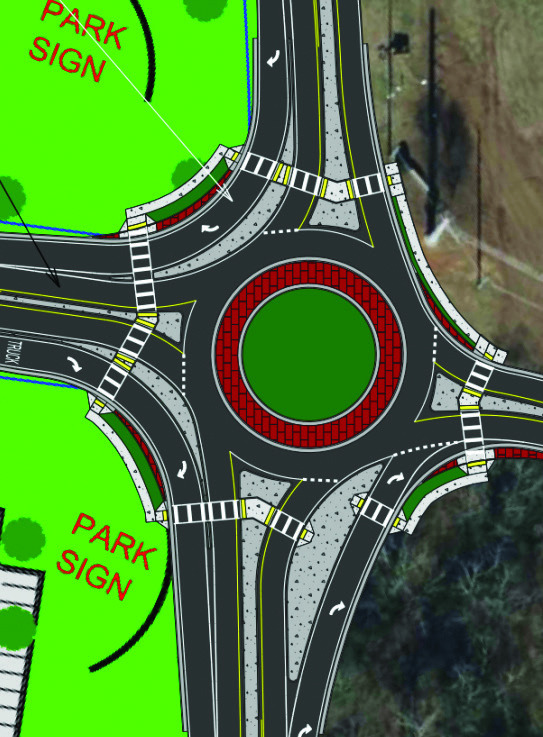
To the surprise of very few, the Madison City Council rejected a zoning map amendment that would have paved the way for a Planned Industrial Development (PID) on 178 acres of property near the intersection of Monticello Highway and Lions Club Road, which is currently zoned I-2.
The specter of increased truck traffic in Madison appears to have been a major reason for the denial.
Had the measure been approved, the PID would have been developed into an industrial park comprising nine buildings, ranging from 113,400 square feet to 267,840 square feet, for a total of 1,839,870 square feet in three phases over more than 10 years.
Phase one of the project was expected to be complete by 2029. Approval would have required changes to the dimensional requirements currently in place for I-2 zoning, which limit building widths and front yard setbacks.
The applicant, J. Gregory Osborne of Longleaf Commercial Properties, had requested that the maximum width of Building 100 be increased from 500 feet to 864 feet and for Building 200 from 500 feet to 648 feet. He also requested a decrease in the setback minimums for all nine buildings from 250 feet to 100 feet.
The developer also wanted to increase the right-of-way from 60 to 80 feet and the road width from 24 to 36 and 48 feet on one driveway, and from 24 to 30 feet on another, and eliminate the sidewalks.
“Our primary request is to supplement light manufacturing through the existing zoning, with light distribution,” Osbourne said. “We expect this to be a mixture of both uses.”
Osbourne said the proposed development might result in 67 percent fewer vehicles, trucks, and passenger cars than the existing zoning might spur, according to his traffic engineers.
Osbourne said the development would eventually create 300 to 500 blue-collar jobs, possibly more, providing opportunities for local young men and women not on a college track.
Osbourne also offered to contribute $1 million toward the construction of a roundabout at the intersection of Lions Club and Monticello roads, expected to cost a total of $3.1 million, part of which could be funded by a federal grant. Trucks would be physically prevented from turning left out of the development onto Monticello Highway toward Madison. Cameras would monitor violators.
Osbourne said the city, county, and BOE currently collect a total of $23,140 in property taxes based on its value, but the completed project would generate $1,623,644 in tax revenue annually.
Drew Addison of Madison spoke in favor of the development.
“That corridor was identified, voted on, and approved for this exact use,” Addison said. “Many developers could come in here and build at a lower quality,y and we have nothing to do about it.”
Shane Seabolt of Morgan County also spoke in favor of the project.
“Recently, we’ve lost industries with Pennington Seed moving one of its main warehouses to Covington, and Flambeau just recently closed and moved out of Madison,” Seabolt said. “Industry, in my opinion, is vital for a stable community. I think this project will be an opportunity for the residents of Madison and Morgan County to seek local employment and gain back some of those jobs we’ve lost.”
The Madison Planning and Zoning Commission had voted to recommend denial of the zoning map amendment due to a lack of proportionate benefit to the community and perceived negative impacts to the city and county transportation network.
According to City Planner Mollie Bogle, installation of a traffic signal at the intersection does not meet DOT requirements, although Osbourne said he would still pursue that option.
The city’s planning department concluded that the development would not adversely affect utilities, schools, police and fire protection, and municipal personnel.
The development would use approximately 34,150 gallons of water per day (GPD) of water and produce 350 GPD of wastewater for the entire property.
Although the zoning proposal appears consistent with the city’s comprehensive plan, truck traffic remains a primary concern in the community.
“Factors to consider when determining suitability include job skills required, long-term sustainability, linkages to other economic activities in the region, and impact of the resources of the area or prospects for creating job opportunities that meet the needs of a diverse local workforce,” Bogle said.
City Engineer Aaron Wadley performed an analysis of the traffic study, which was completed to examine the development’s impact on the city’s travel network.
“The majority of the 1,049 daily truck trips are expected to take Monticello Highway to and from I-20,” Wadley said. “The developer states physical barriers and lease terms will require this. SEI, the traffic engineer, assumes the current traffic distribution will continue. This represents 51 additional truck trips projected to use Main Street daily, or four or five per hour during the typical workday, or an additional truck every 10-15 minutes, including during peak hours.
“This represents a 5% increase in truck traffic on Main Street, and up to about 30 additional truck turns at Main Street and Washington, based on historic GDOT data; 340 additional passenger car trips are possible on Main Street, which will be notable during peak hours.
“Another intersection of particular concern is the infamous ‘triangle’ (Main Street at Eatonton Road). The project is anticipated to make this intersection function 220% worse after fully built. Some of this additional volume is likely to be distributed throughout the grid, putting traffic and pressure on residential streets.”
Wadley said that when the development is fully built out, 1,200 to 1,800 employees will be entering and leaving the facility each day.
“There are severe traffic implications,” Celia Murray of Madison said. “Truck traffic is one of this community’s primary concerns. This development is expected to put 1,000 trucks on the roads in Madison and 3,000 cars.”
Betsy Wagenhause made the motion to deny the request, with Eric Joyce providing a second. Rick Blanton voted against the denial.