


It was standing-room only on June 8 at the Greene County Historical Society Museum.
The meeting was a special presentation that had been months in the making. The Greene County Historical Society hosted Jack Bowen and Jack Hatcher, who have a keen eye for historical artifacts and a spirit of preservation.
Bowen is the owner of BLDR, Inc., a large building and construction company with sites in 48 states. Hatcher owns and operates Hatcher Deerfield, Inc., a strategic planning, development, governance, and investment business. The two often collaborate in business, as well as in their shared passion for history, particularly the history and artifacts of the Civil War.
A few months ago, retired judge LaVerne Ogletree, herself a guardian of Greene County historical treasures, received a call from Hatcher. Emails and phone calls ensued as preparations were made for the arrival and historic presentation by the two learned experts with a story to tell, connecting Greene County with a historic announcement and a mystery solved.
Hatcher and Bowen arrived in Greensboro, keen to investigate historical landmarks and discover more about this storied town and its significant contributions to early times, predating and including the Civil War.
They made a discovery during their driving tour of Greensboro, led by GCHS Vice President Judy Hodnett. Remains of the foundation of a crumbling Leech and Rigdon pistol factory were uncovered on South Street. The Confederate pistol factory operated in what was once the Griswold Cotton Gin Company, converted to produce Colt-pattern revolvers for the Confederate States Army.
The factory focused on producing a six-shot 36-caliber Navy revolver, with brass replacing steel only on the backstrap. Production at the Greensboro site began in February 1863. The supplier of munitions was moved from its original Memphis location to Columbus, Mississippi, and to Greensboro, as the forces from the North closed in on the Memphis and Columbus factory sites. Greensboro was the destination for a business supporting the rebels’ fight for freedom and self-governance.
The factory was a vital source of weapons for the Confederacy, but in November 1864, it was burned by Union forces.
Following their driving tour of Greensboro, Bowen and Hatcher joined a few GCHS members for dinner, featuring pork chops, buttermilk pie, and chocolate cake, courtesy of Yesterday Café, along with lively conversation reflecting their finds of the day around Greene County.
At the museum meeting, Bowen and Hatcher gave an informal and entertaining presentation on philosophy, facts, and artifacts of the Civil War, including a recounting of stories of heroes on and off the battlefield. They described the significant contributions of Greene County and its rebel fighters, as well as a lively band of patriotic and dedicated women who supported the soldiers.
Bowen described the mindset in the South and towns like Greensboro in the lead-up to and during the Civil War. His narrative included a discussion of Greensboro’s namesake, Nathanael Greene, a general in the Continental Army during the American Revolutionary War, who served from 1775 to 1783. He initially served under Gen. George Washington, eventually becoming quartermaster general and later commanding the Army of the South.
Although he never fought a battle in Georgia due to a physical injury acquired early in life, he was eager to serve. Appointed commander, Greene was largely responsible for supplying food and munitions to the continental soldiers. In fact, he sold his fortune and took on debt to finance the needs of his fighting soldiers. He led a campaign that ended the British occupation of the South, freeing Georgia from British forces.
Greene died at the age of 44 and did not witness the proclamation of the United States' independence at the end of the American Revolutionary War. Nonetheless, he was a hero and illustrated the tenets of justice and freedom that hold true today.
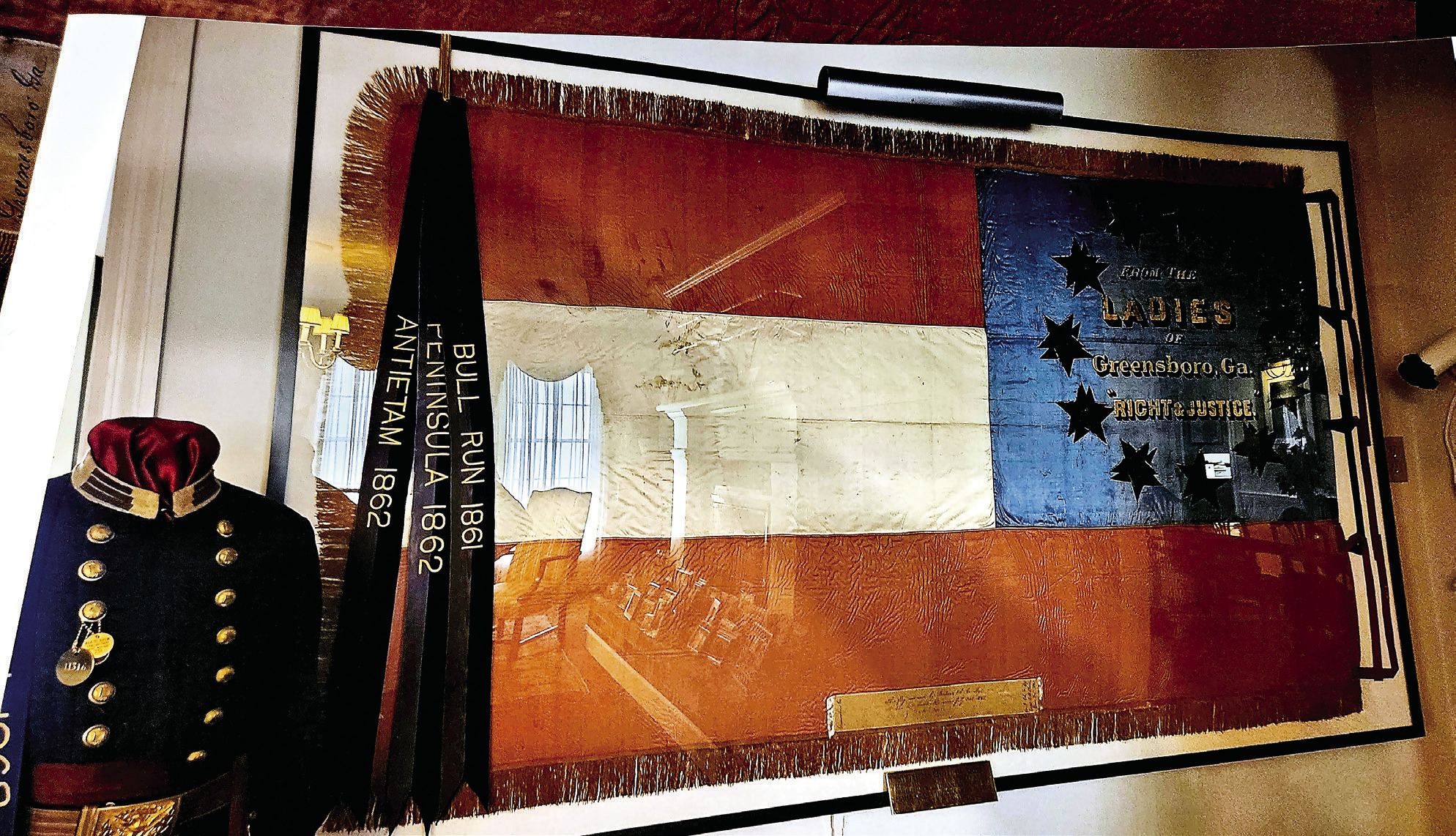
Hatcher is well-known for his keeping and preservation of significant artifacts from the Civil War, namely, swords, uniforms, and flags. He described receiving a call one day informing him of the existence of a special artifact, which had been kept in a man’s home in a shoebox for over 80 years. It was the Stephens Light Guards Flag, long thought to be lost.
Sgt. James Price McCall was awarded the flag in 1862 at the end of the Civil War. McCall was a flag sergeant for the Stephens Light Guards and was wounded twice and held as a prisoner of war. The flag was a gift in honor of his bravery.
At that time, a new flag was issued by the Richmond Depot, the Flag and Uniform Ordinance Division of the Confederate Army in Richmond. The new, square Andrews Cross replaced the older flag.
The Stephens Light Guards Flag was passed down in the man’s family and resided with a relative and in the same home for over 100 years. The owner wanted the flag to be “kept” by someone with expertise and enthusiasm for such an artifact. He chose Hatcher, who went on to reveal that this flag was listed in the national registry as “missing or lost” for over 80 years.
The significance of this newly discovered flag and its connection to the Civil War and Greensboro were thoroughly researched by its new keepers, Hatcher and Bowen.
Hatcher’s connection with the final owner led to the acquisition of the flag, and well-researched steps were taken to restore and preserve the Civil War treasure.
Hatcher continued the recounting of the flag’s origin and historical significance. It began with the Women of Greensboro, an organization of women who had the flag constructed and donated the silk masterpiece adorned with shadowed stars to a special company of 108 men, sworn in at the Greene County Courthouse on June 12, 1861. They were attorneys, farmers, and ranchers who banded together to form the Stephens Light Guards, named for the Honorable A. H. Stephens, a distinguished statesman and Georgia politician. He served as vice-president of the Confederacy.
As the story goes, the Stephens Light Guards were gathered for a farewell to friends and set out for Richmond, to defend the right to freedom and self-governance. A special dinner was presented to the men, and the send-off included a presentation of the flag.
According to the Augusta Weekly Chronicle and Sentinel (June 12, 1861), when Stephens Light Guards commander Captain G.O. Dawson received the flag, he said “Violent bands, never could wrest it from his noble band as long as we live to bear it aloft, and should the last man fall beneath its folds, be only asked that it might serve as his winding sheet.”
The flag is claimed to have been in the hands of Gen. Francis S. Bartow, when he led the charge and fell at the first land battle of the Civil War, the Battle of Manassas, on July 21, 1861, referred to as “Bull Run” by Northerners.
Bartow was the first officer killed in the Civil War. It is said that as Bartow fell, shot in the chest, he fell as Dawson predicted “beneath the folds of the flag serving as his winding sheet,” leaving bloody handprints, still in evidence on the body of the fabric.
The meeting continued with the sharing of artifacts brought by attendees for validation and discussion by the experts.
Greene County Sheriff Donnie Harrison presented Hatcher and Bowen with “challenge honor coins,” which included the Greene County Jail in the background. The large crowd stayed on for conversation and questions about the presented artifacts and future collaborations with the experts.