
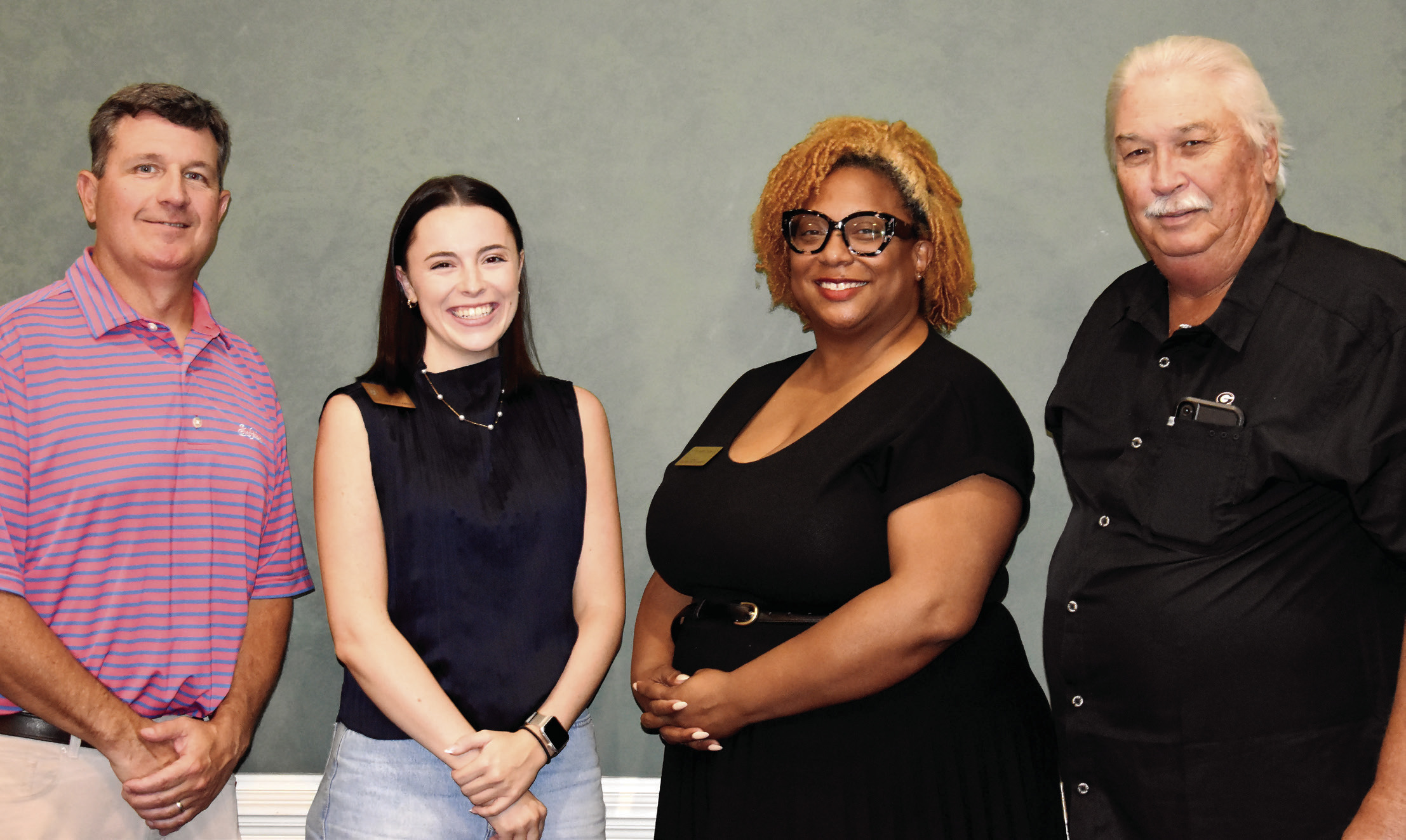
The Greene County Farm Bureau held its annual legislative supper on Aug. 26.
Leaders said the annual supper recognizes those who serve the community and state and thanks them for their work. Attendees included local officials, candidates for local races, state leaders, and representatives from the offices of U.S. Sens. Jon Ossoff and Raphael Warnock.
During the supper, attendees heard from Greene County Board of Elections vice-chair Bob Lofgren, who stressed the importance of voting early, especially when submitting absentee ballots.
“We started accepting applications for absentee ballots on Aug. 19,” he said. “We have a problem in Greene County with the mail. Our two senators are doing a great job helping us; our 10th district representative, Mike Collins, is doing great. The problem is the problem’s not solved. If you’re going to vote absentee, soon as you get that ballot send it back to us or have a family member or guardian bring it back to our office. We’re getting valid absentee ballots for the last primary up until last week. The mail is that bad. We’ve spoken to both people here in Greene County about the mail; they point their fingers at Atlanta. If you’re voting absentee, please get it to us as quickly as possible.”
“I want you all to vote,” Lofgren added about the election season. “It’s very, very important. You can complain, yell, and scream [about issues], but it’s time to vote.”
During the supper, attendees also heard from Hope Iglehart, the North Georgia outreach coordinator for Ossoff’s office. She said Ossoff is working to protect the Produce Act. He is also working on the Temperature Endorsement for Multi-Peril Policies Act, which includes promotional resources from the U.S. Department of Agriculture. Iglehart said Ossoff is also a co-sponsor of the Specialty Crop Act of 2023, which works to bring Georgia’s specialty crops, like pecans, to the global market. Ossoff also worked with Republicans and Democrats to commit $3 million to establish the Precision Agricultural Laboratory at the University of Georgia’s Institute for Integrative Precision Agriculture.
“Sen. Ossoff remains dedicated to supporting Georgia's agricultural initiatives,” Iglehart said. “If I can assist you, please let me know.”
Katrina Cochran, outreach representative for Sen. Warnock, also spoke at the supper and offered her assistance.
“I grew up on an Angus farm [in Cherokee County], so I know the work that you all do,” she told the Farm Bureau. “I know you’re hard workers because I’m the daughter of a hardworking farmer and the granddaughter of a hardworking farmer. I’m here for you if you ever need to talk about anything. I'm your go-to gal if you ever need to talk to anyone at Sen. Warnock’s office. I’m happy to be down here any time. I love Greene County.”
She also discussed the federal farm bill that must be reauthorized every five years.
According to the American Farm Bureau Federation (AFBF) website, the 2018 bill was extended until Sept. 30, 2024, but the next bill hasn’t seen much traction in Congress.
“The farm bill has kind of stalled in Congress right now,” Cochran said. “We’re doing as much work as we can. I think once we get some traction on it, hopefully, things will start moving.”
AFBF president Zippy Duvall also spoke of the farm bill, echoing the need for more traction.
He said the bill has passed the House of Representatives’ agriculture committee but has not been introduced to the floor. He also said the Senate needs a companion bill.
“It’s an uphill battle, but I know if they make up their mind that they’re going to do it, they can get it done,” Duvall said about passing legislation. “Eighty-five percent of the farm bill goes to nutritional products that feed our children, our schools, and help people who need a ‘hand-up’ (not a hand-out).”
He says the other 15 percent, focused on risk management tools for farmers, will become critical in the next few years as interest rates increase while crop values decrease.
“We are spending a lot of time in AFBF on mental health because our farmers and ranchers are coming up against a wall,” Duvall explained. “We’ve got corn at $3.90; that’s half the price it was in 2022. If someone said you were going to get half your paycheck, how do you think you would feed your family? That’s what our farmers are facing next year. Without a farm bill providing risk management tools that modernize and recognize the true cost of production, there’s no way they will survive. In this country, food is a national security issue.
"Without us being able to feed ourselves, we’ll have to depend on some other country to feed us, and they’ll bring us to our knees. If we thought energy was important to us, we would find that food is way more important than energy. We need people to go to work for the people who need their assistance and nutritional products, and for farmers who need risk management tools.”
“[Sen. Ossoff and Sen. Warnock] have worked with me a lot,” Duvall noted. “We haven’t got anything done, but we’ve had the opportunity to have some really good discussions.”